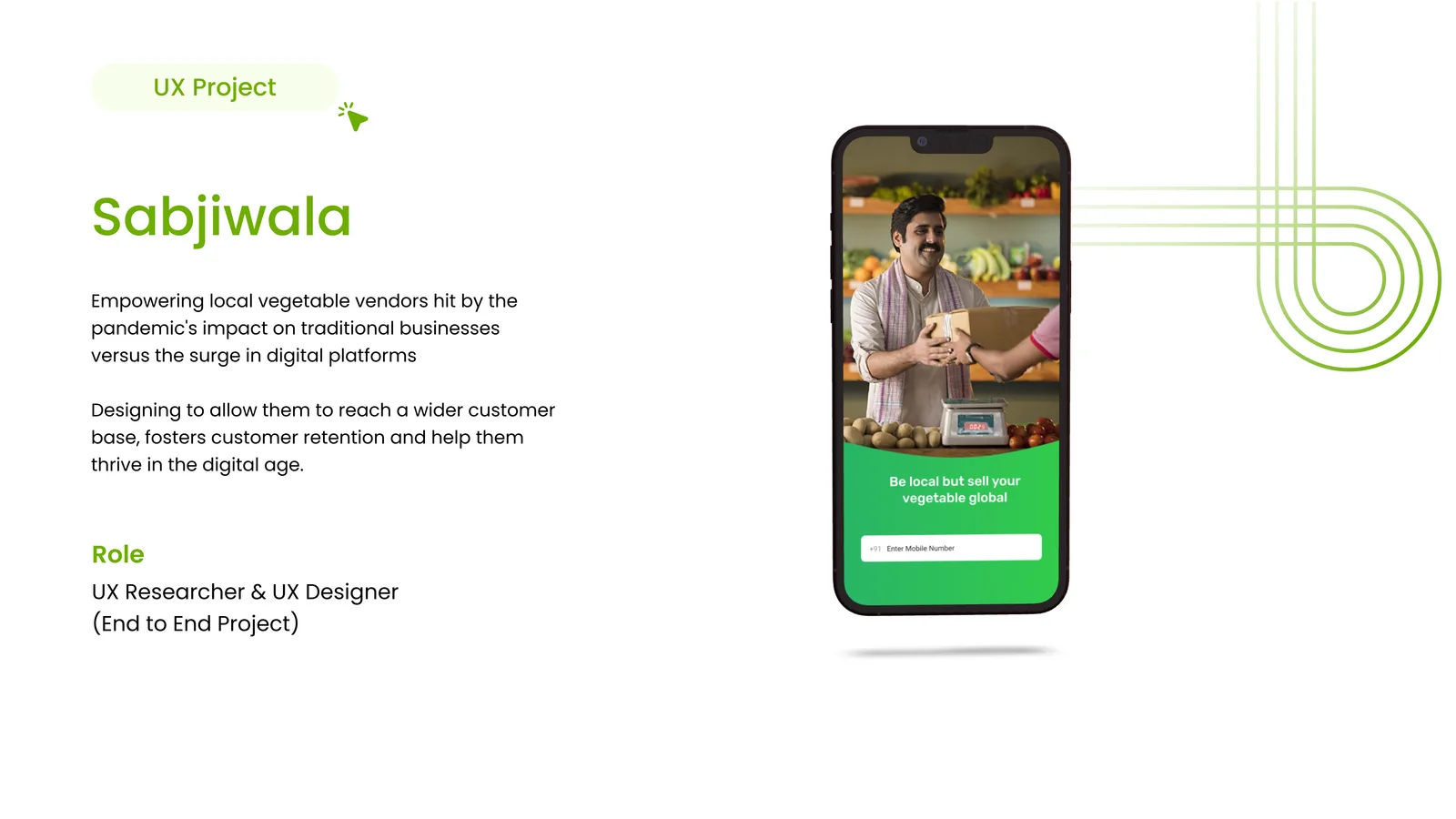
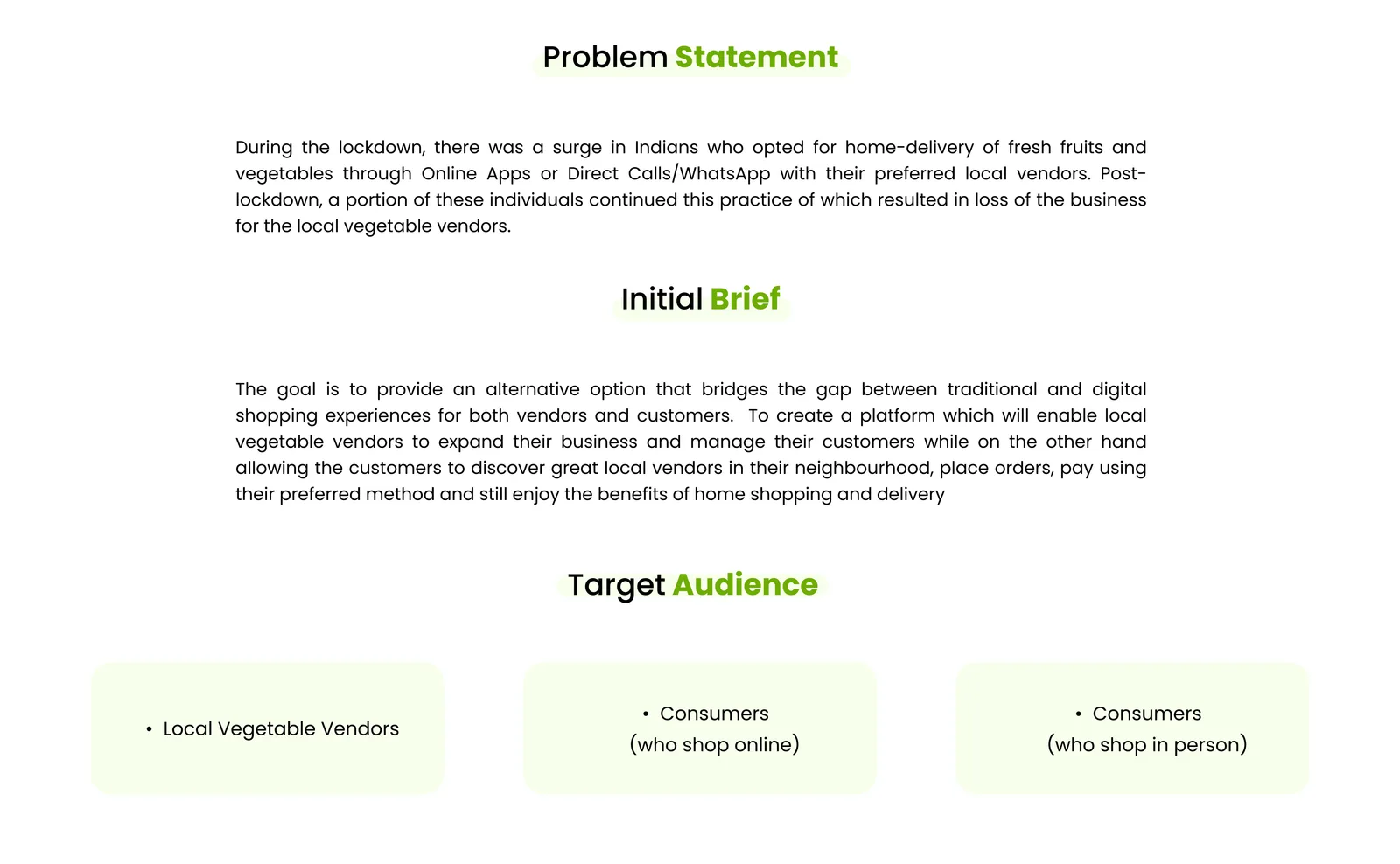
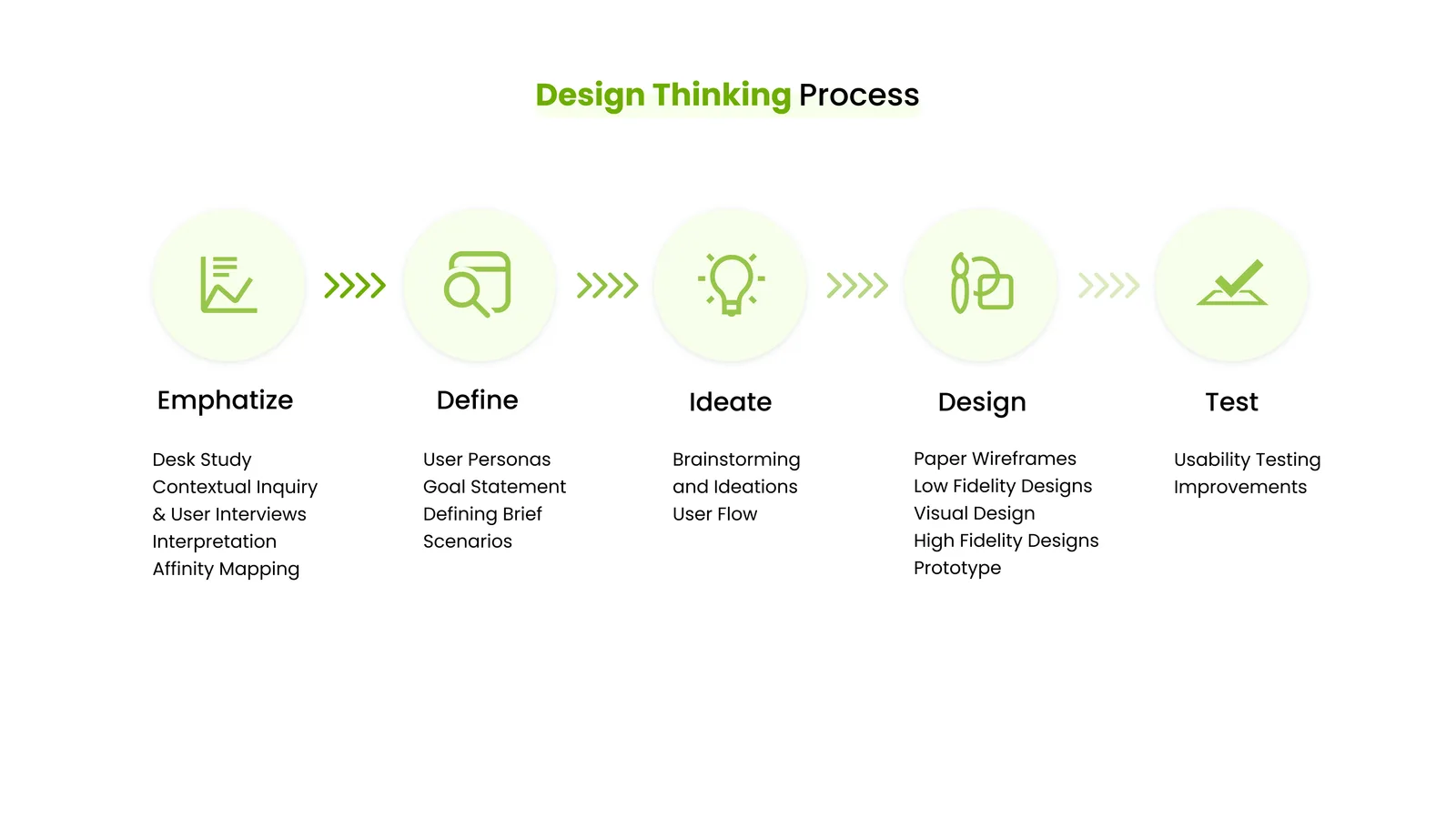
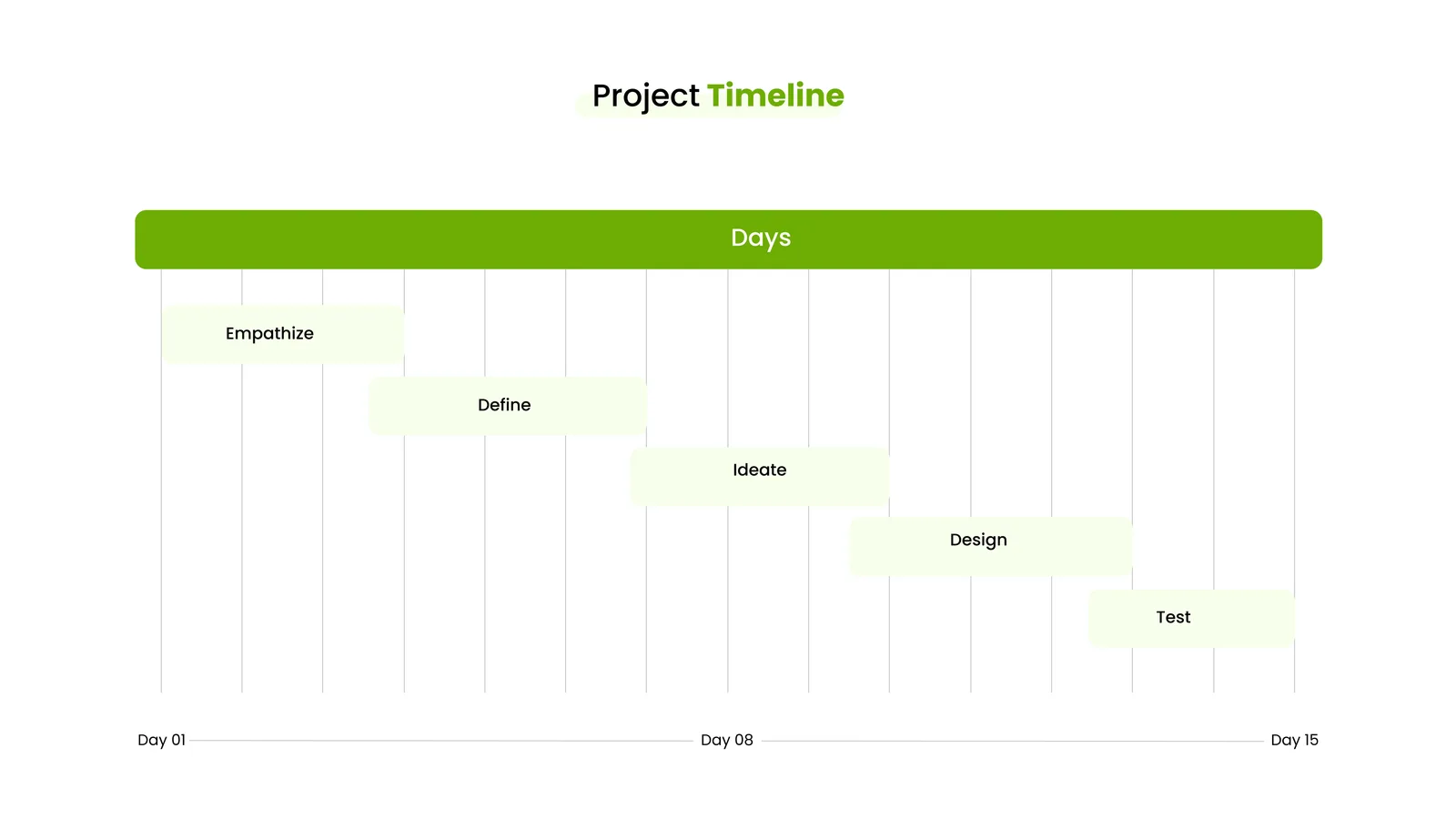
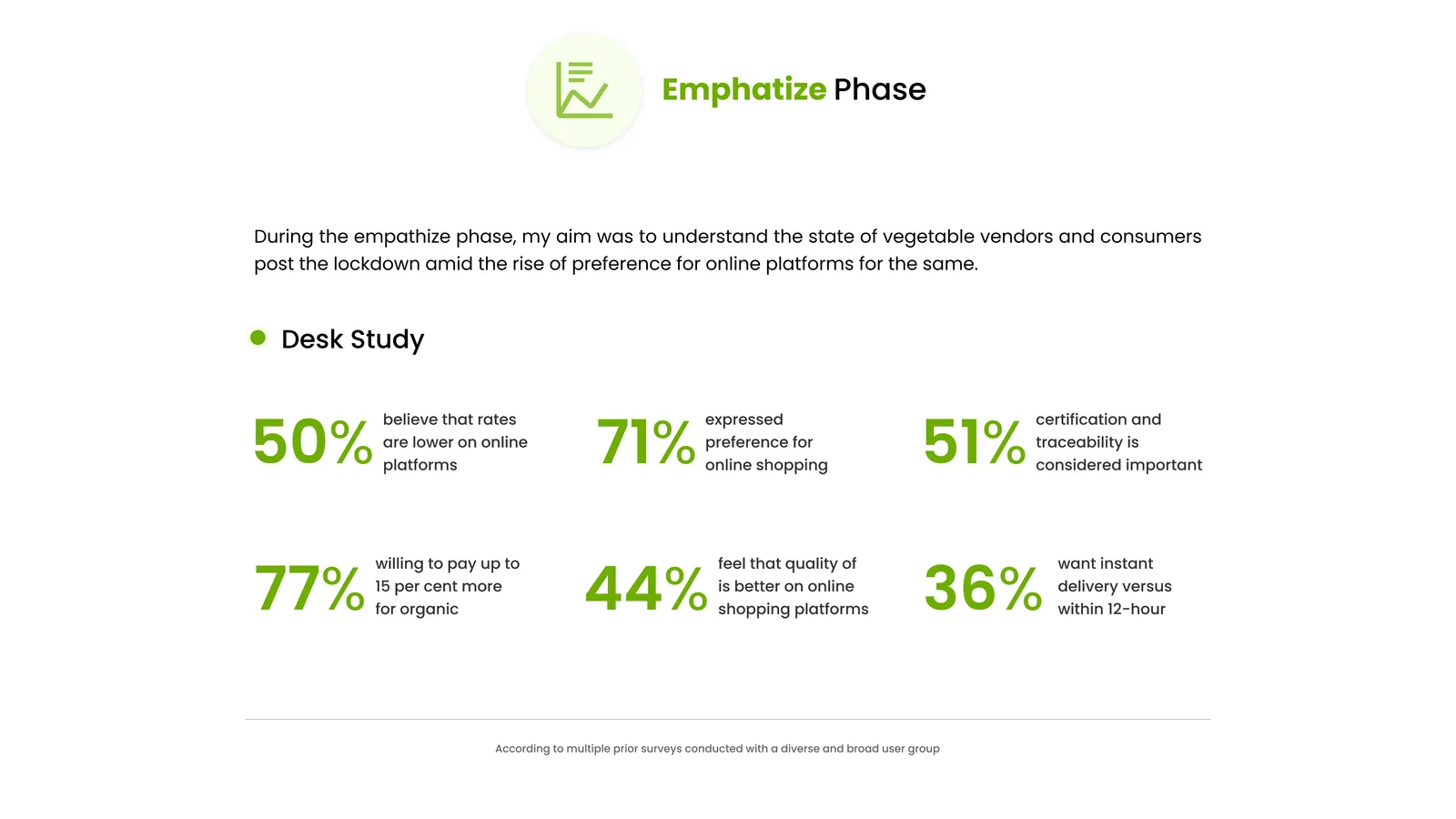
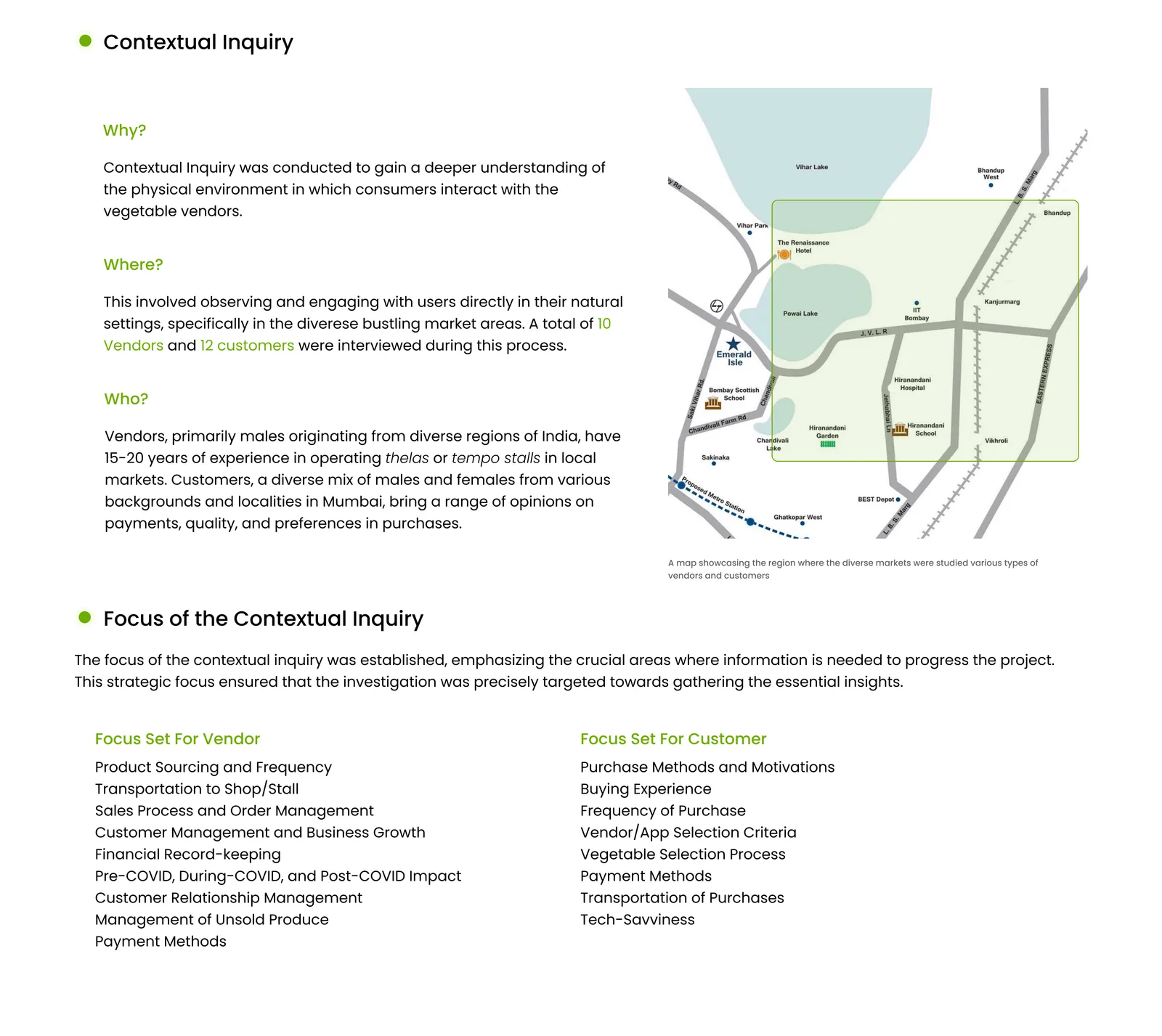
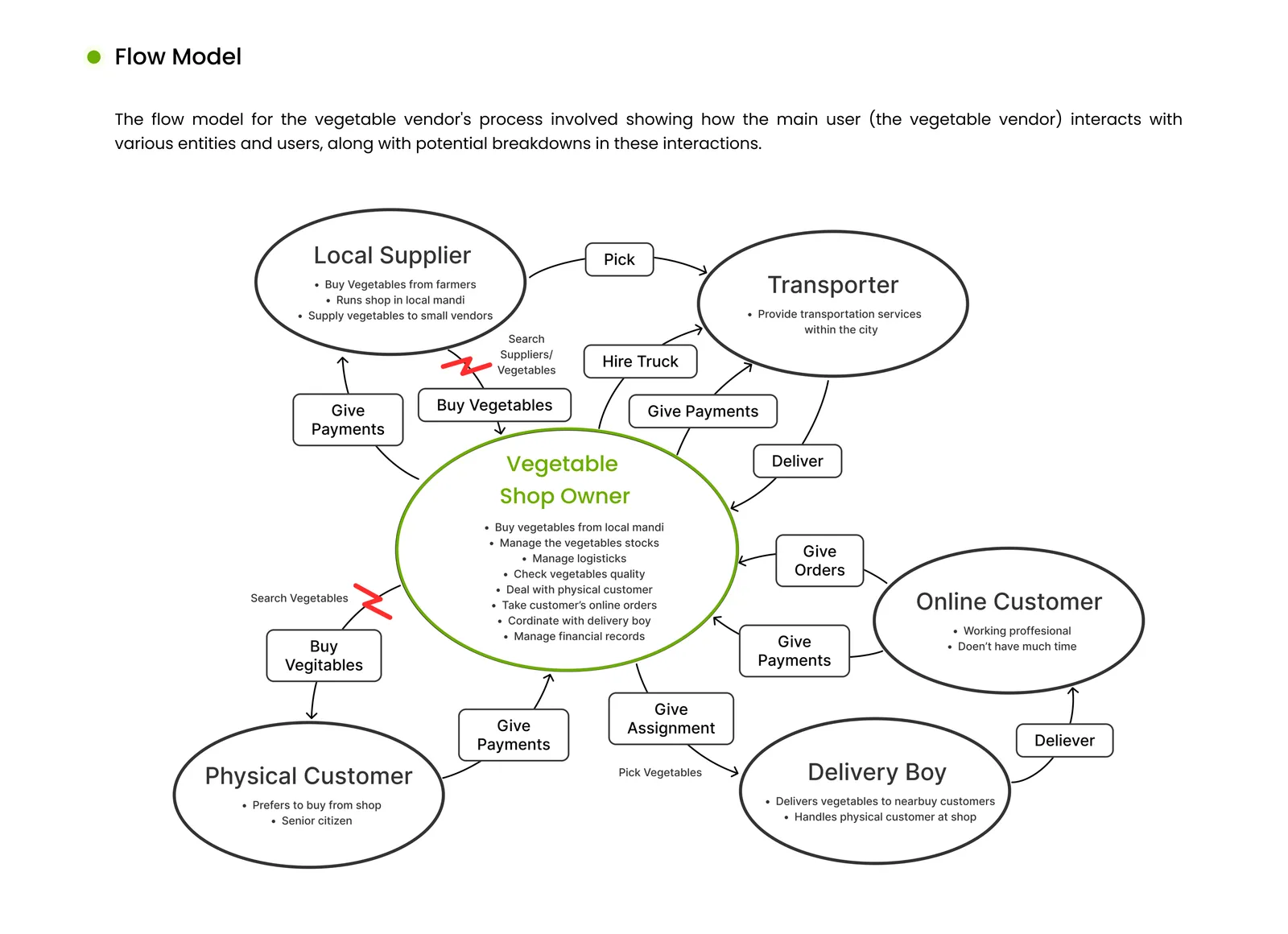
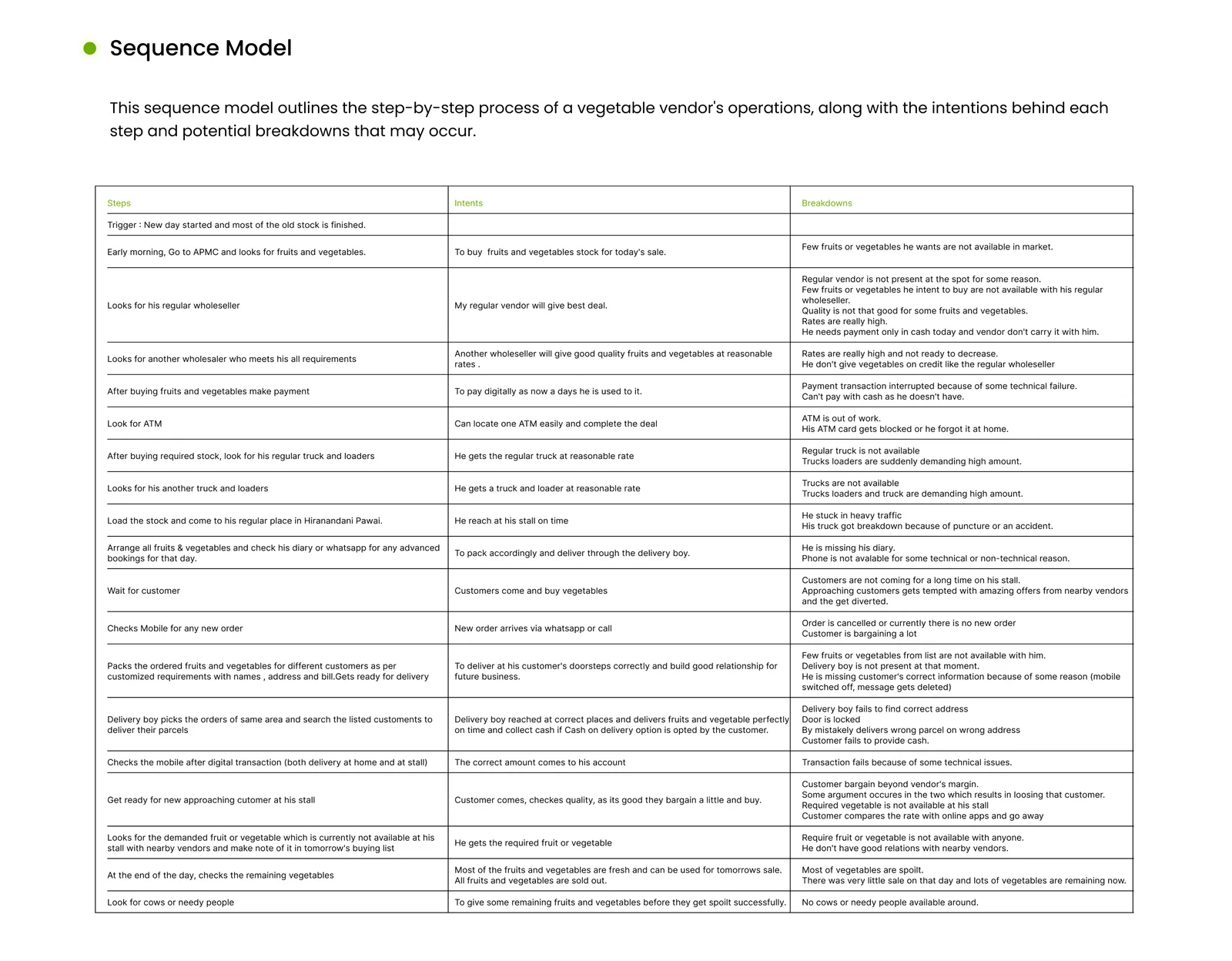
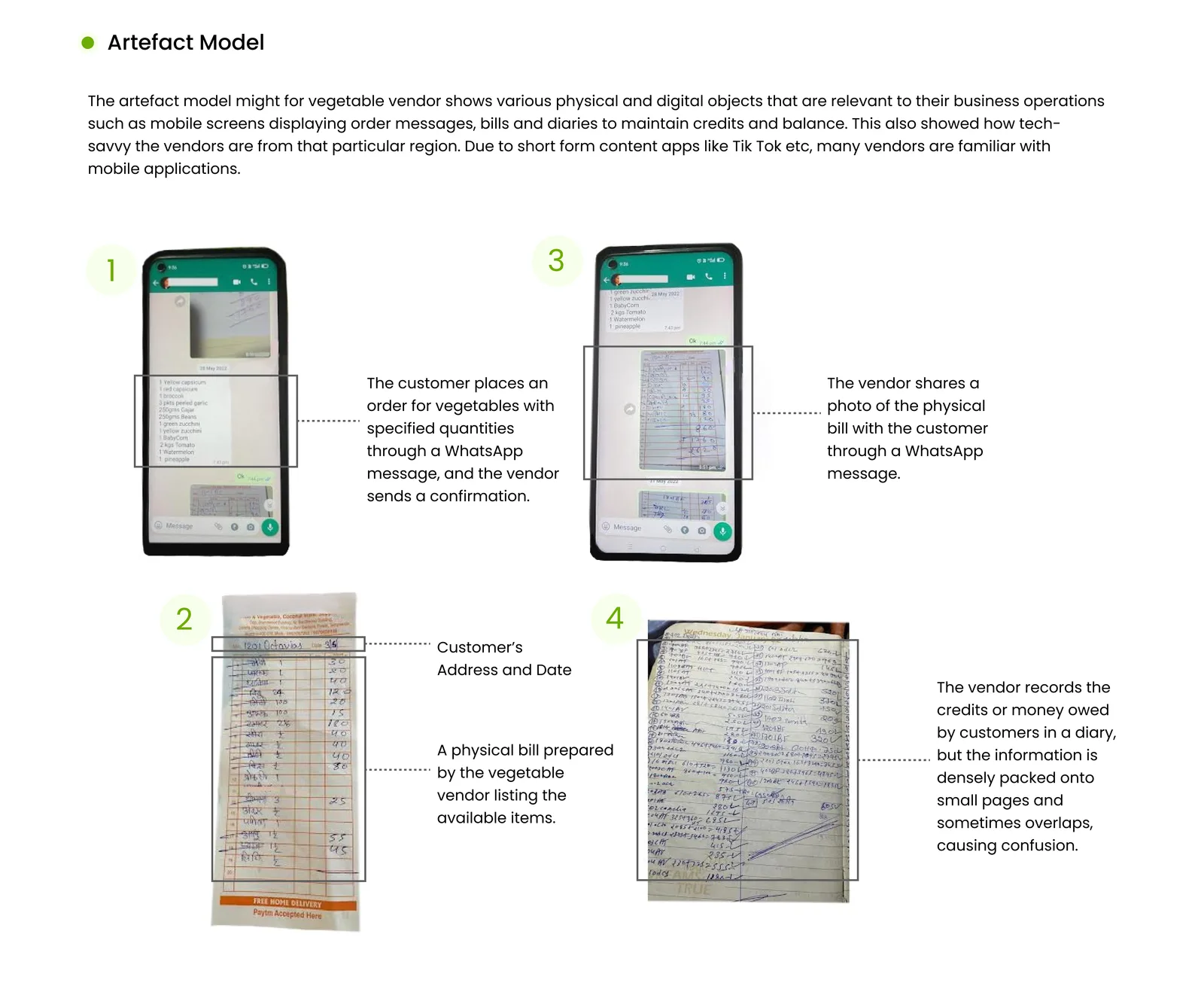
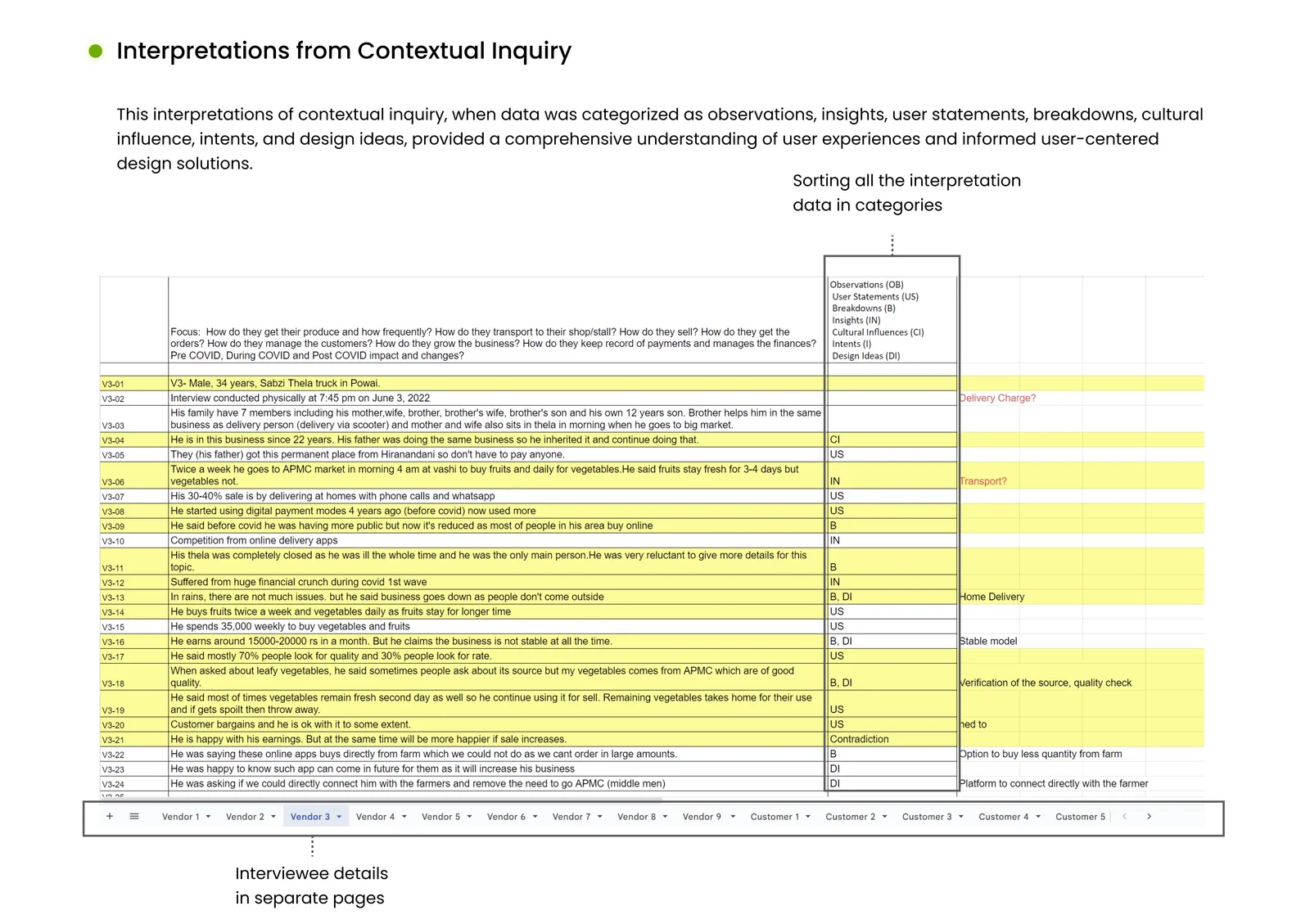
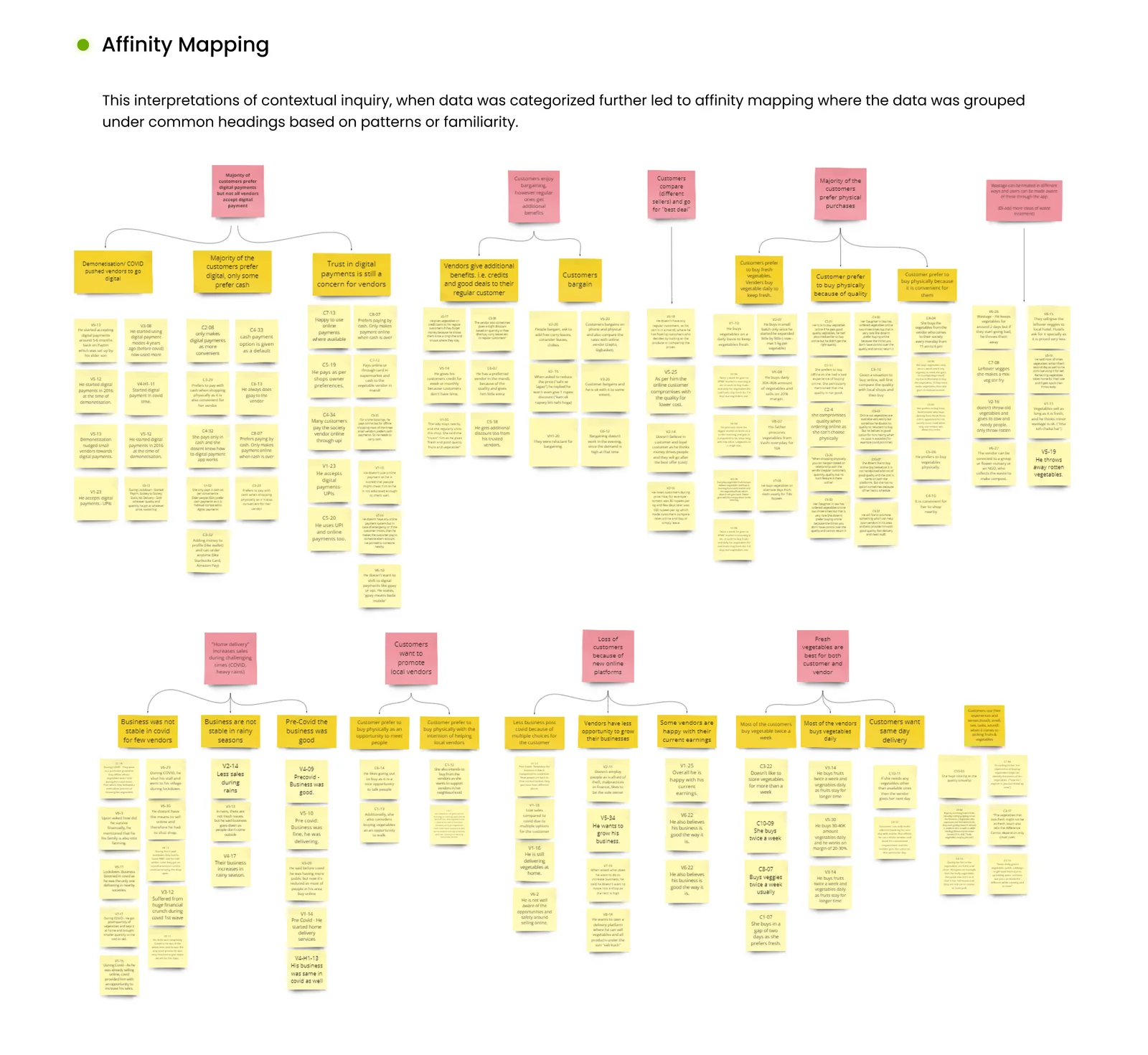
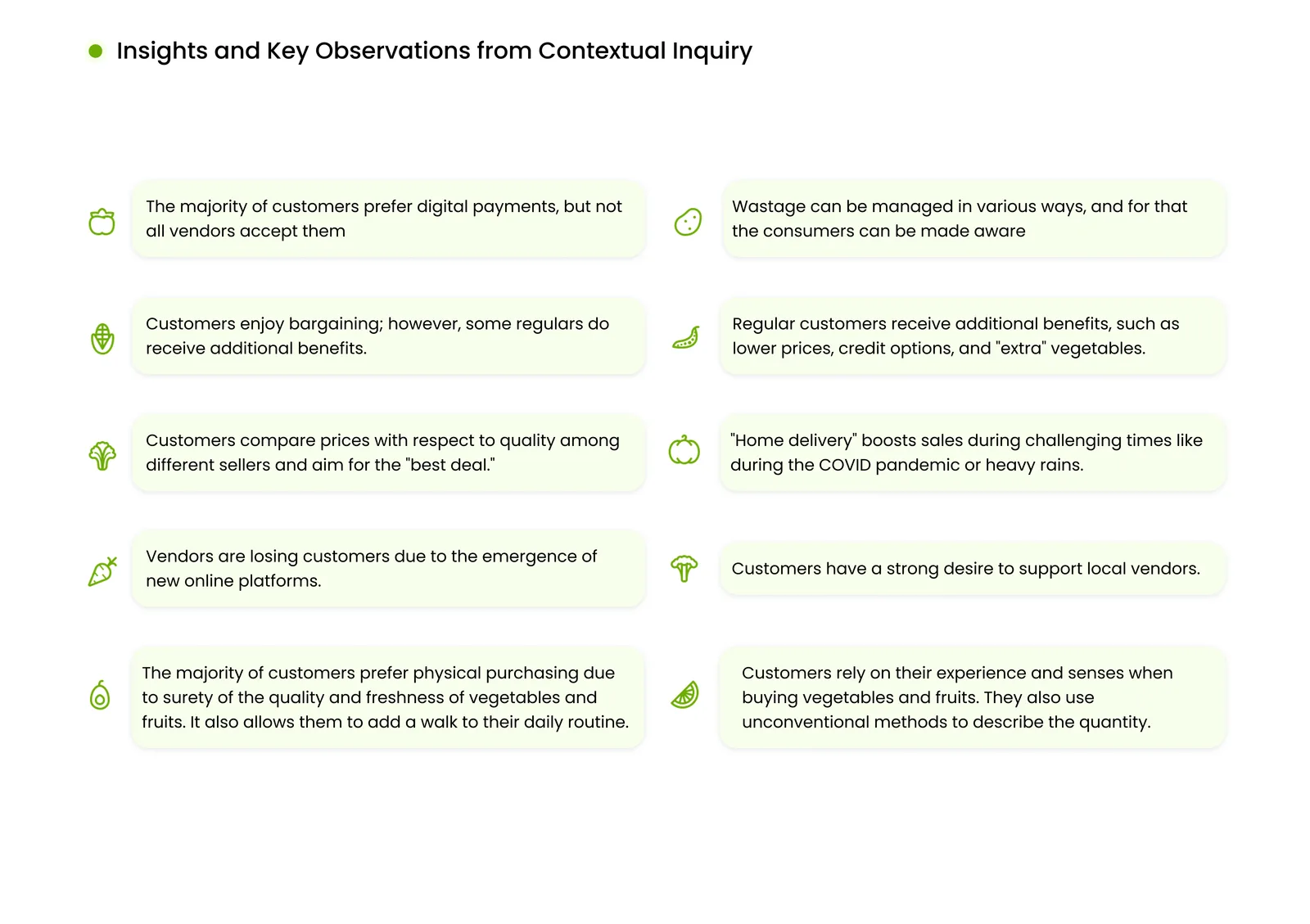
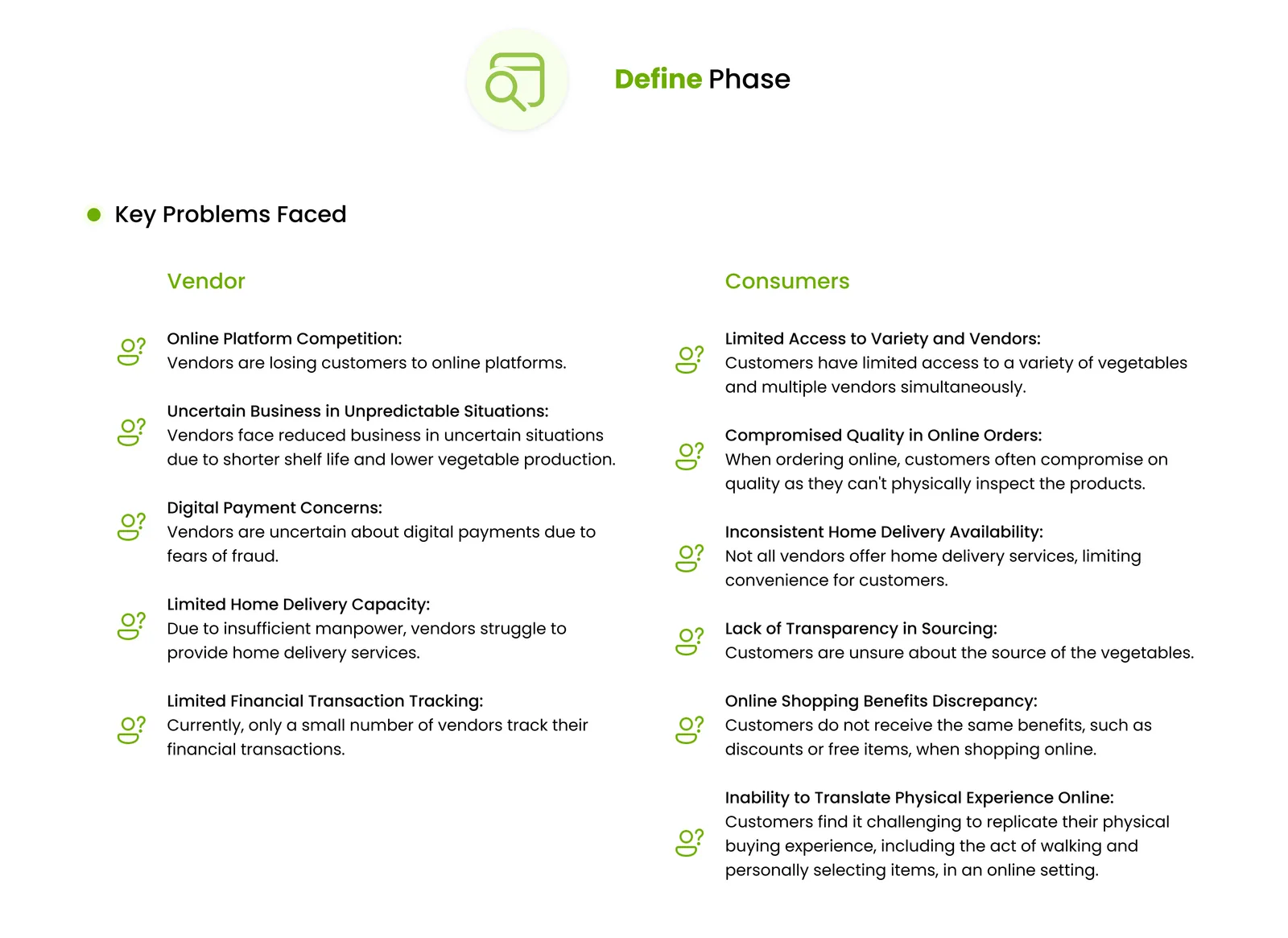
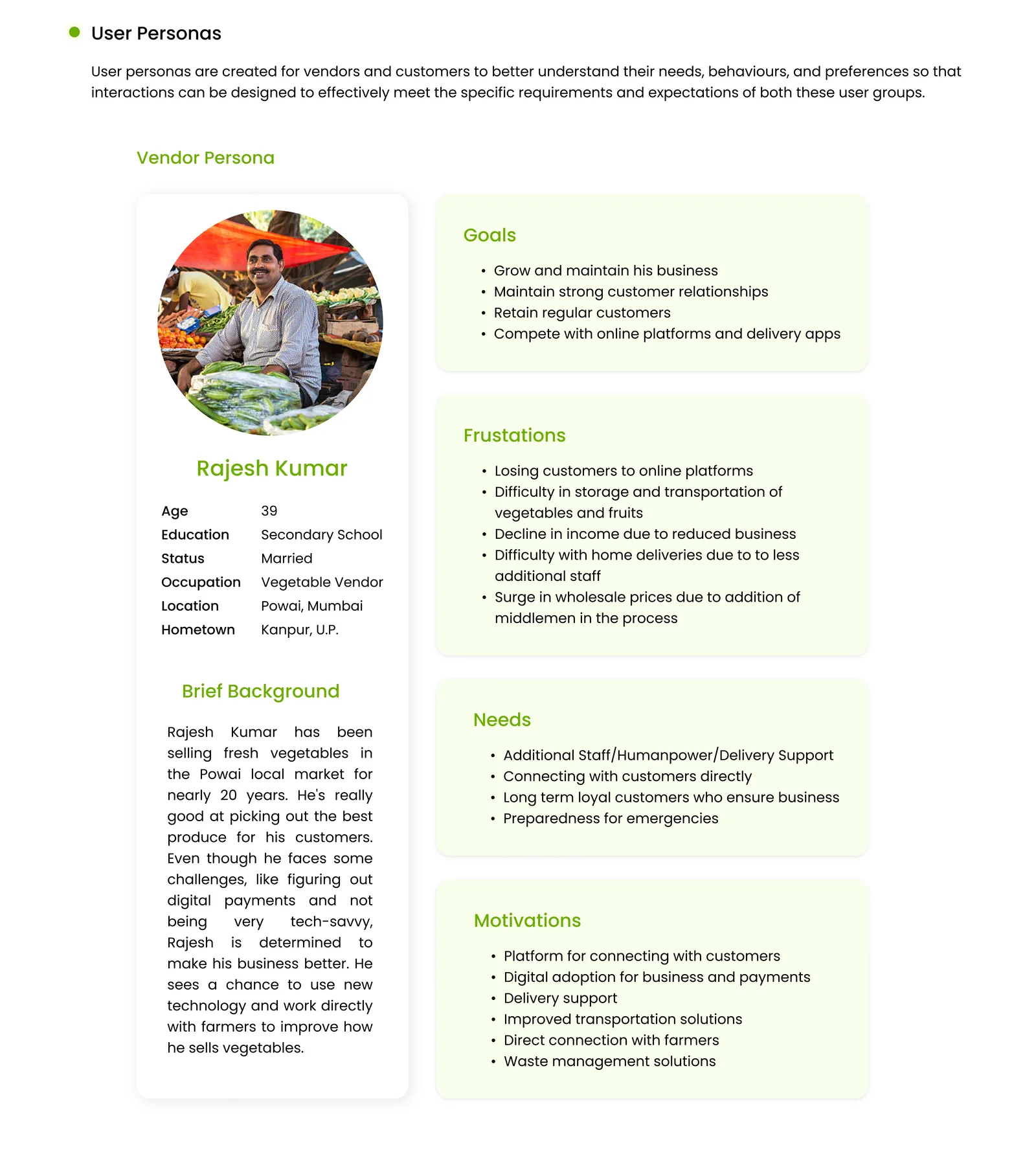
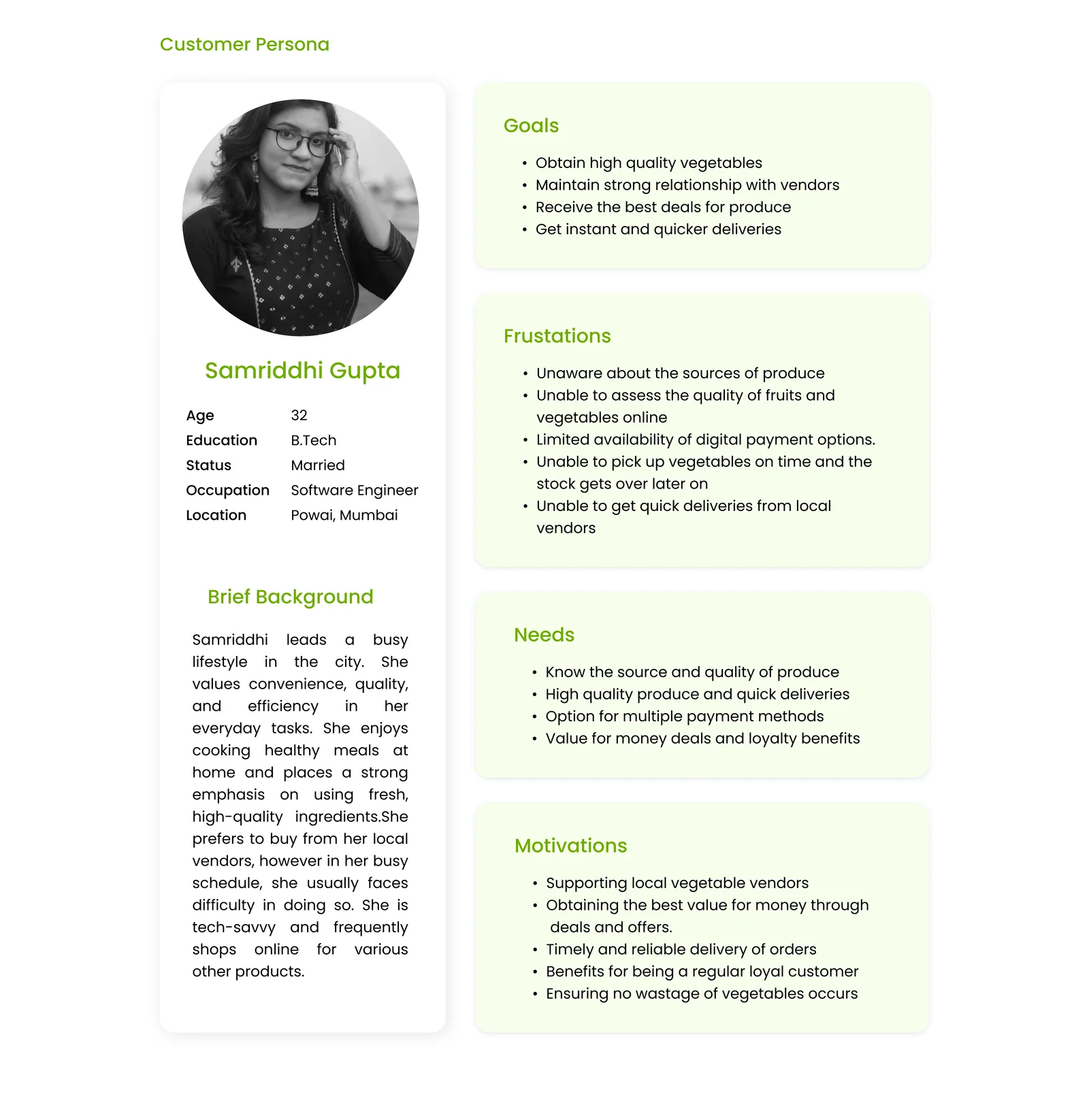
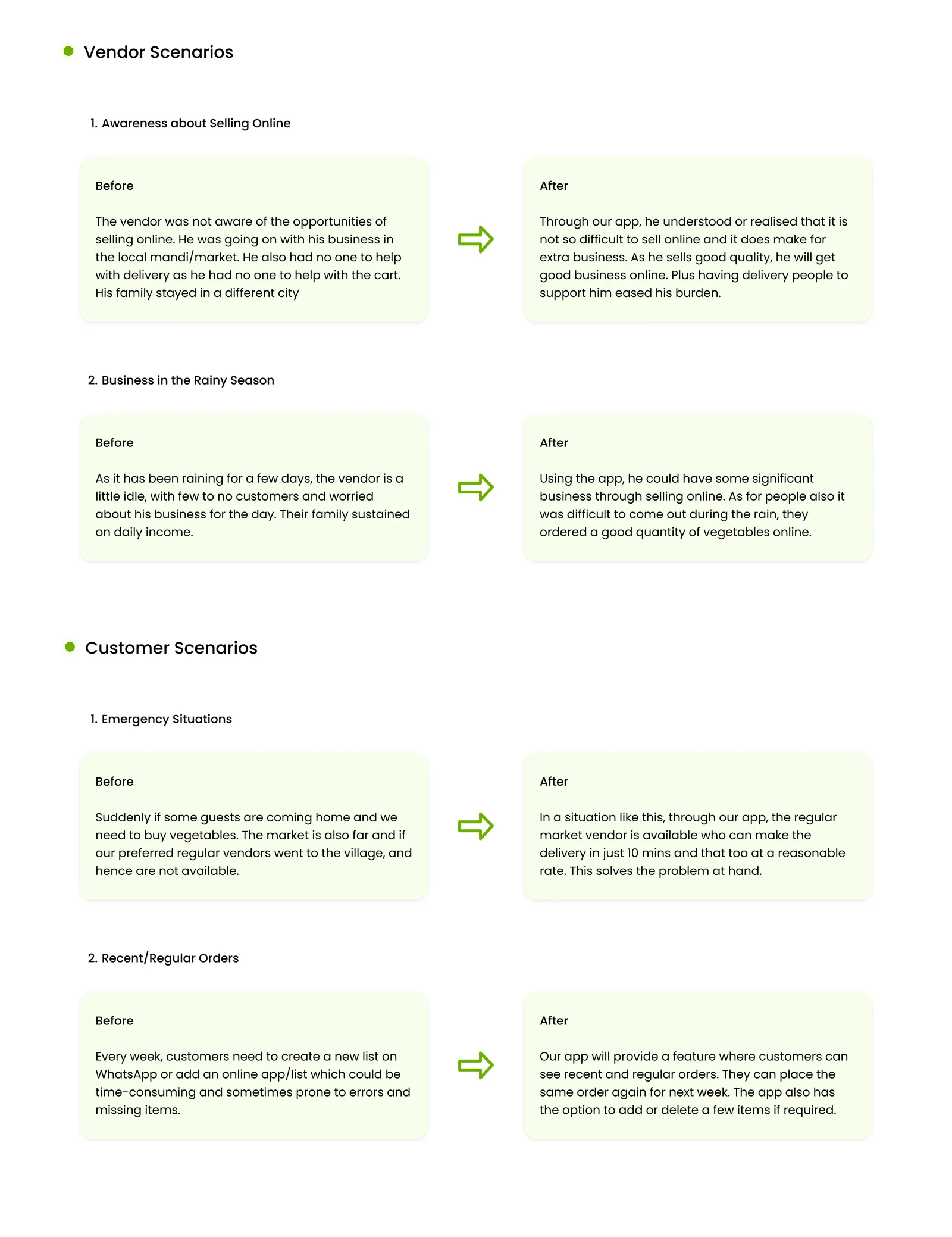
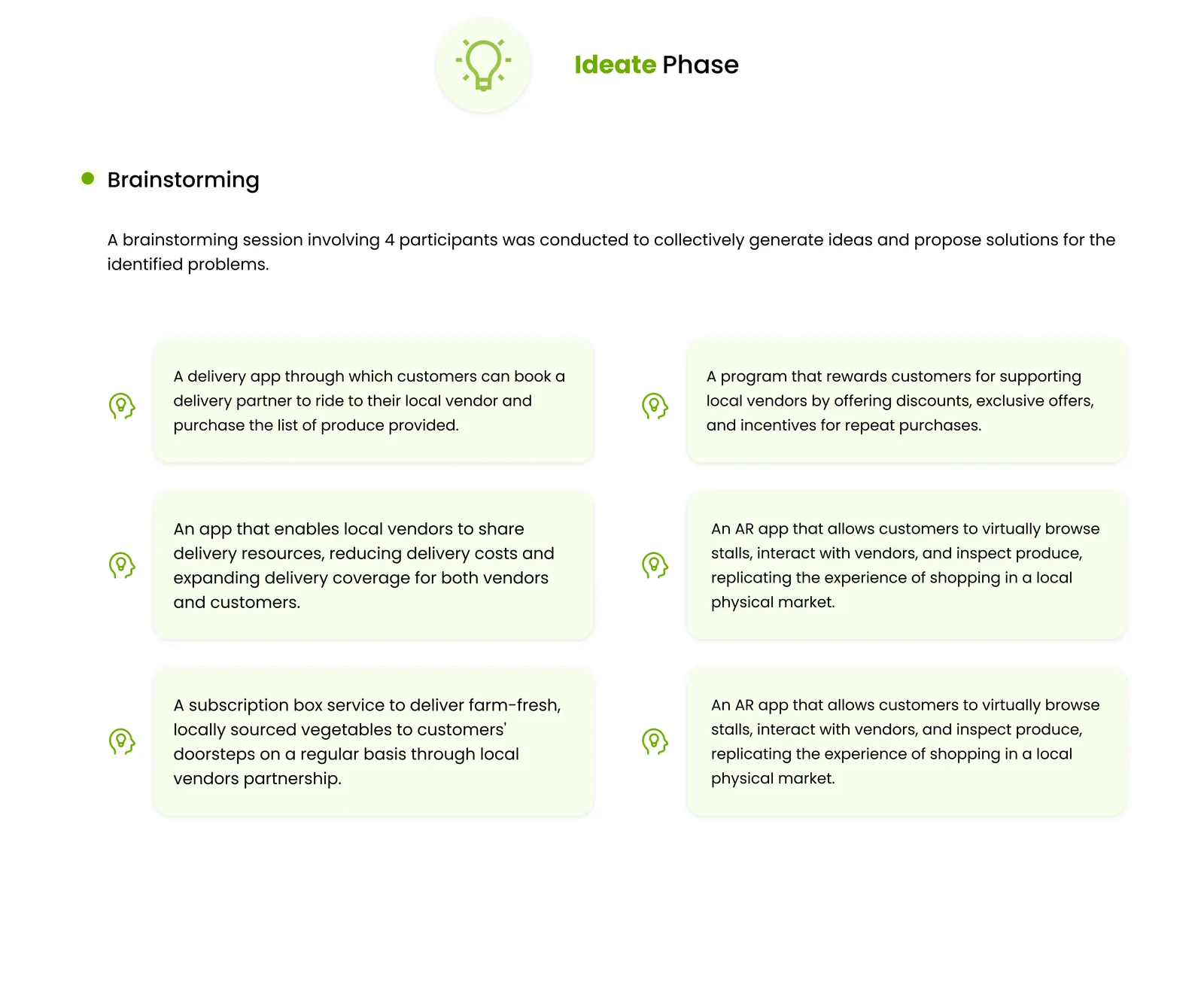
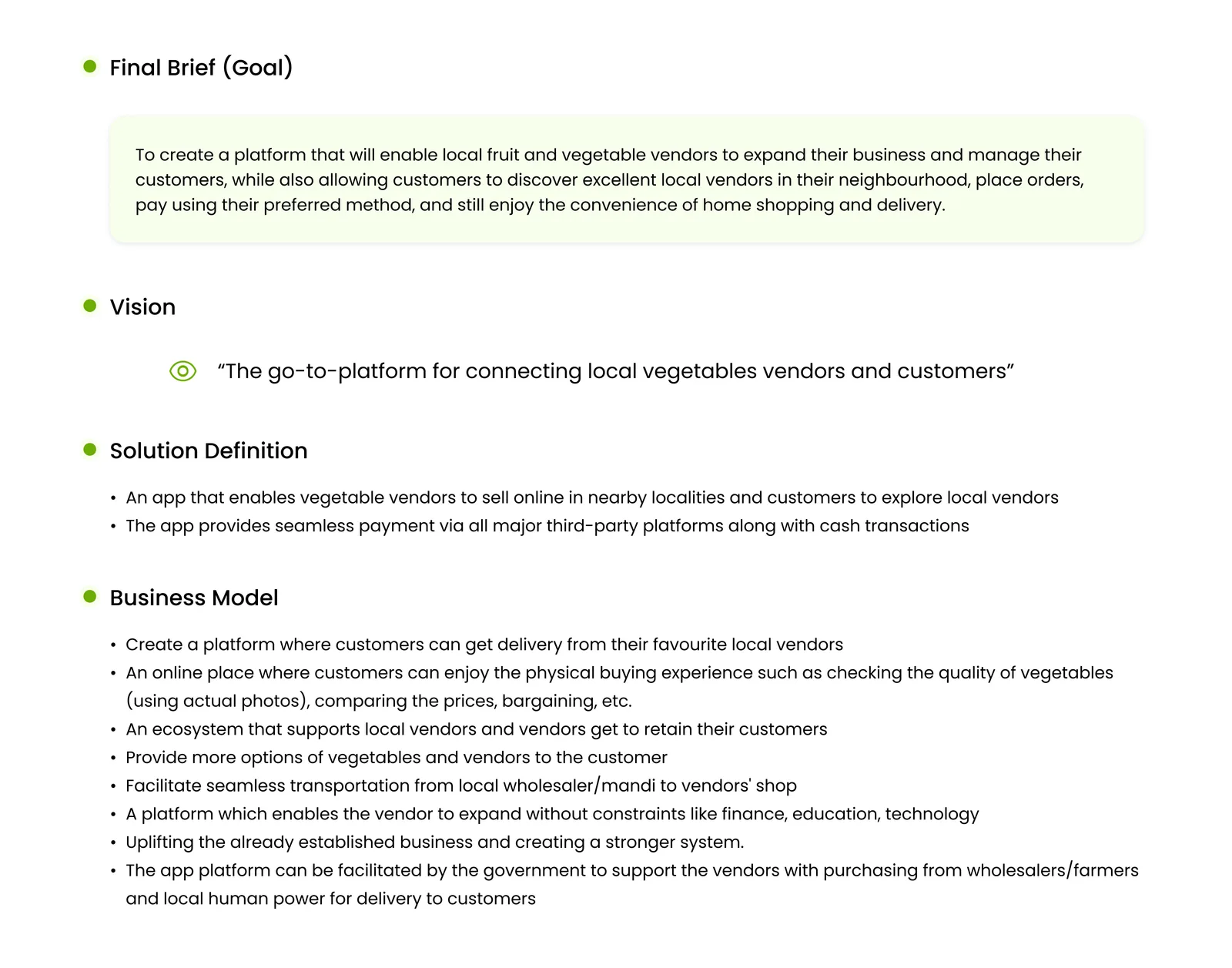
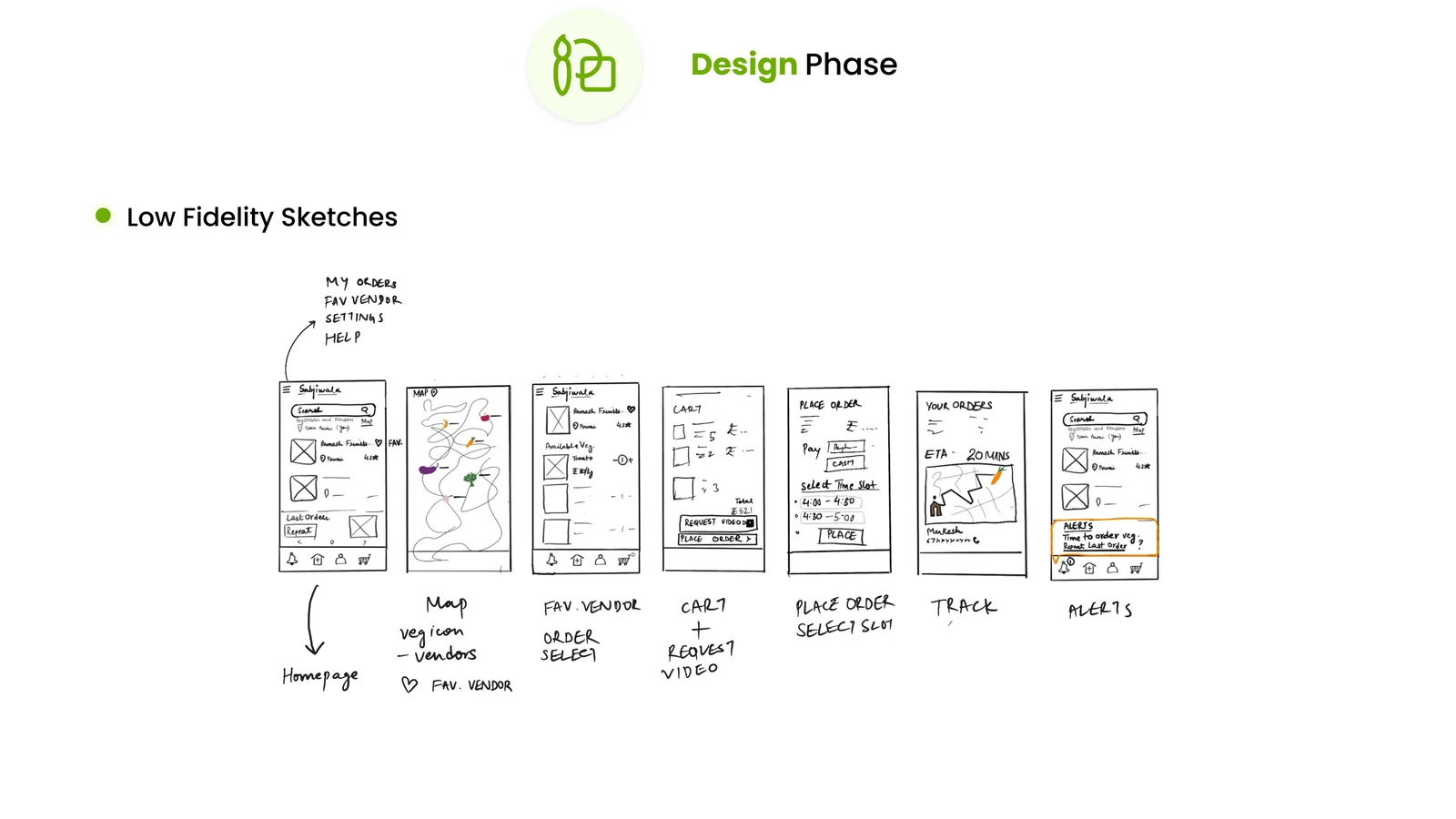
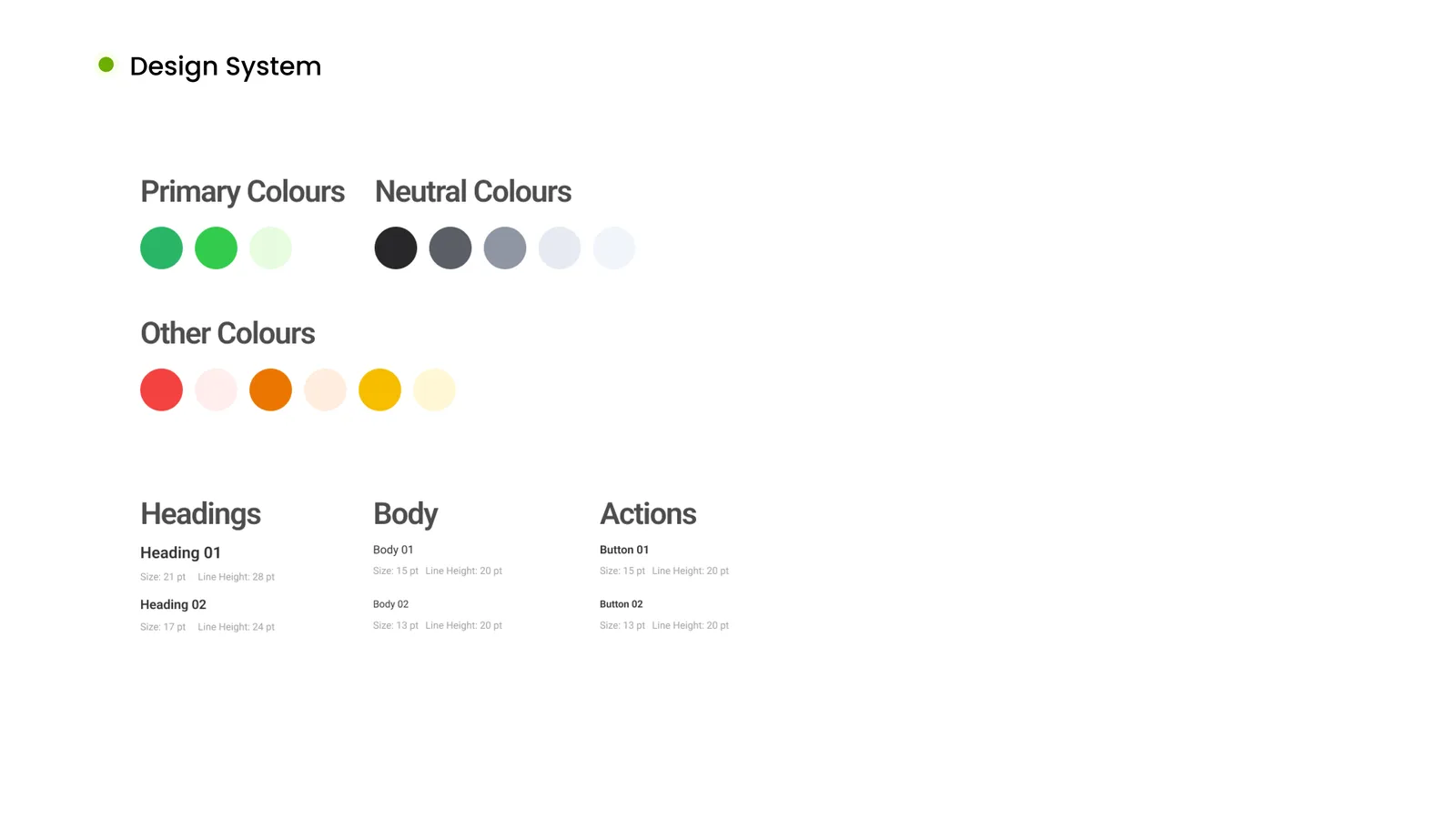
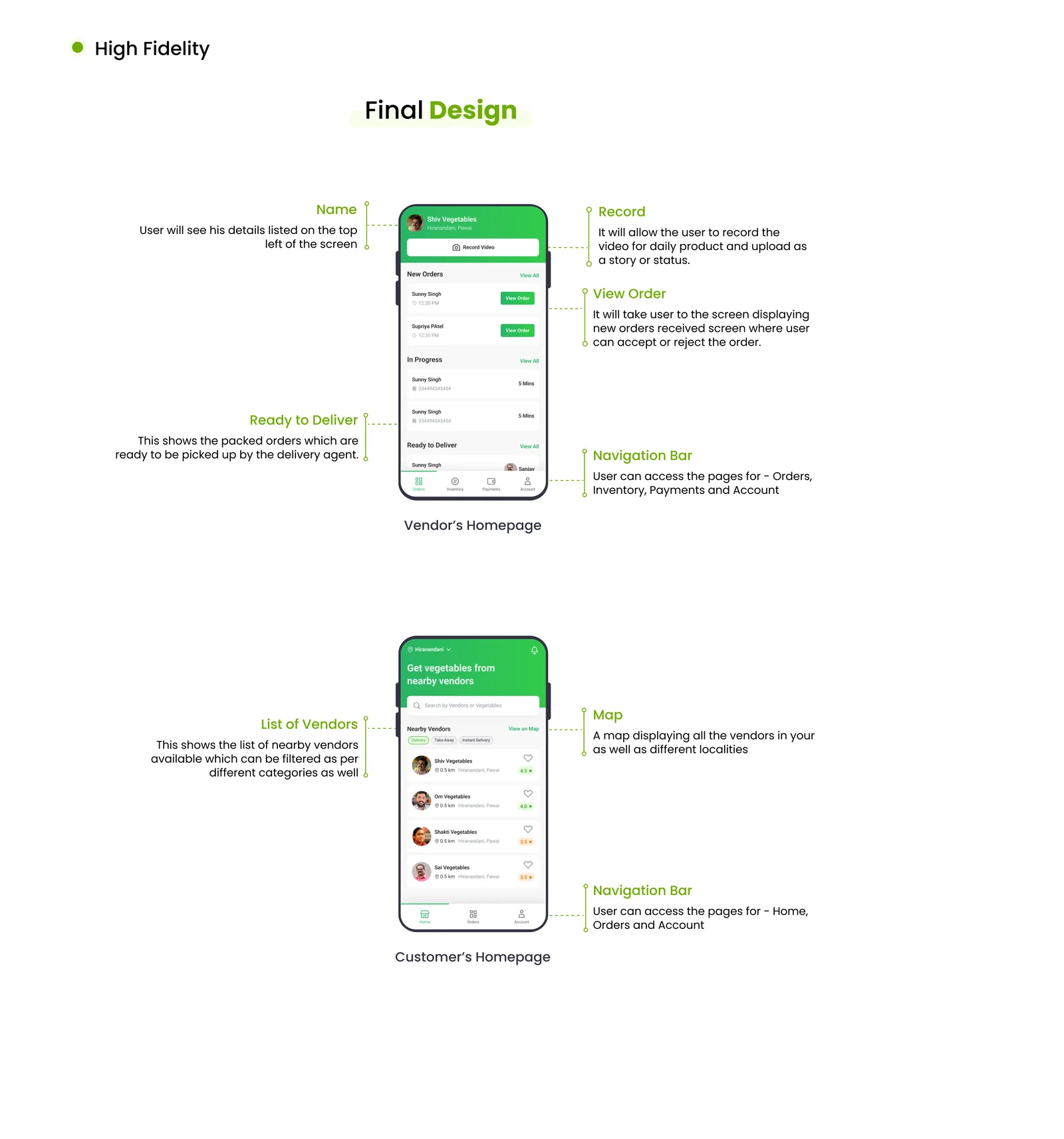
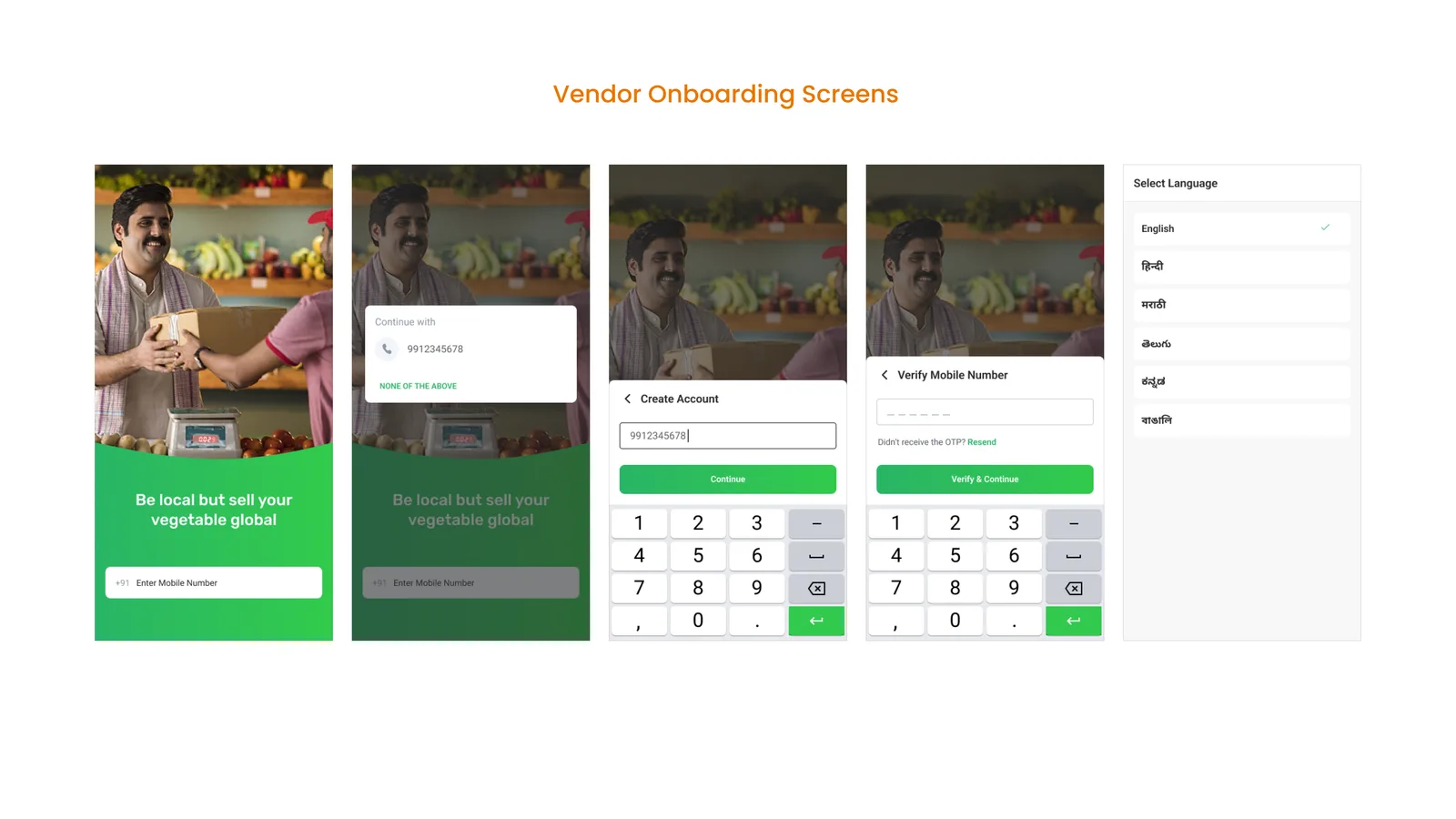
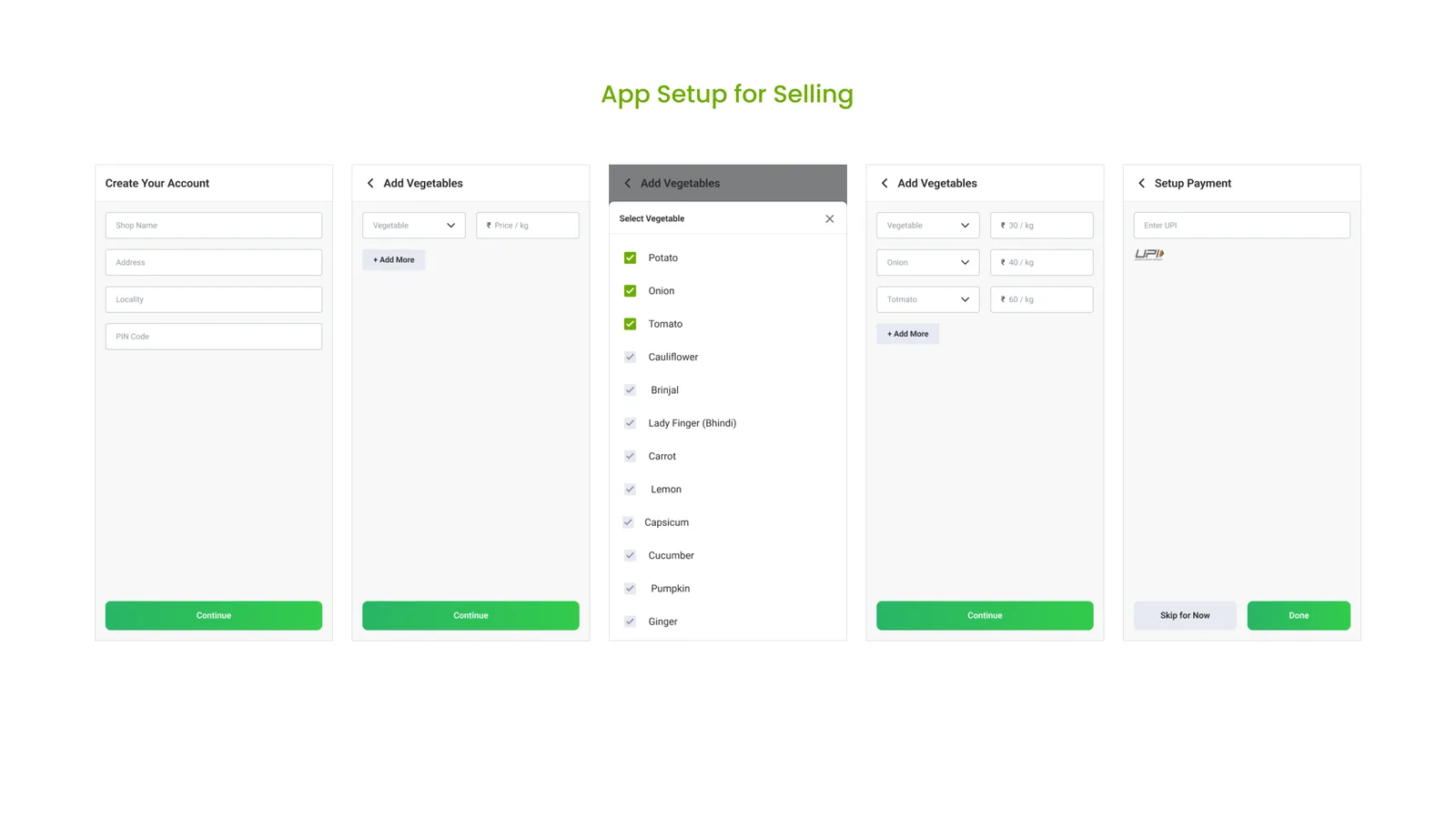
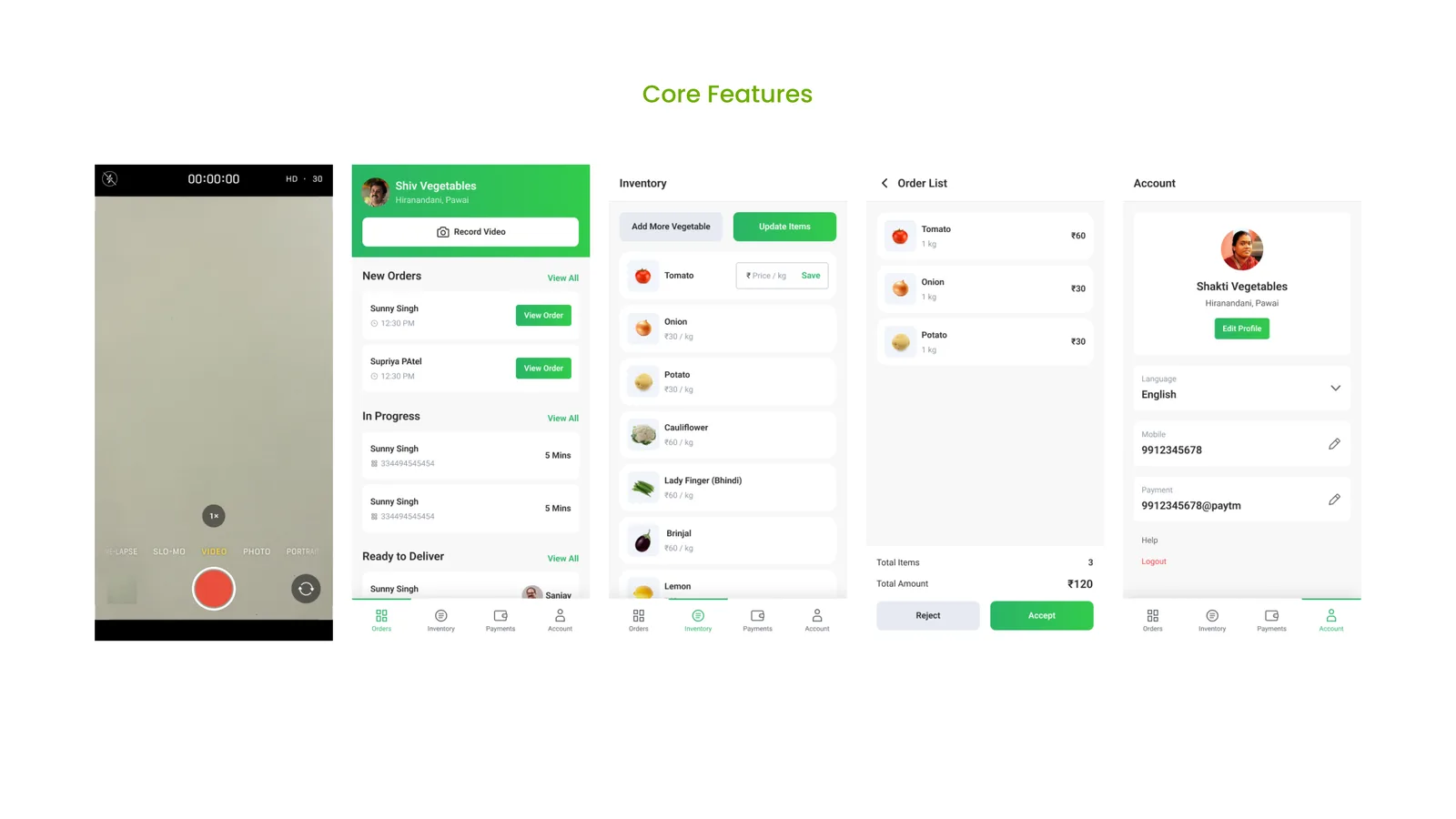
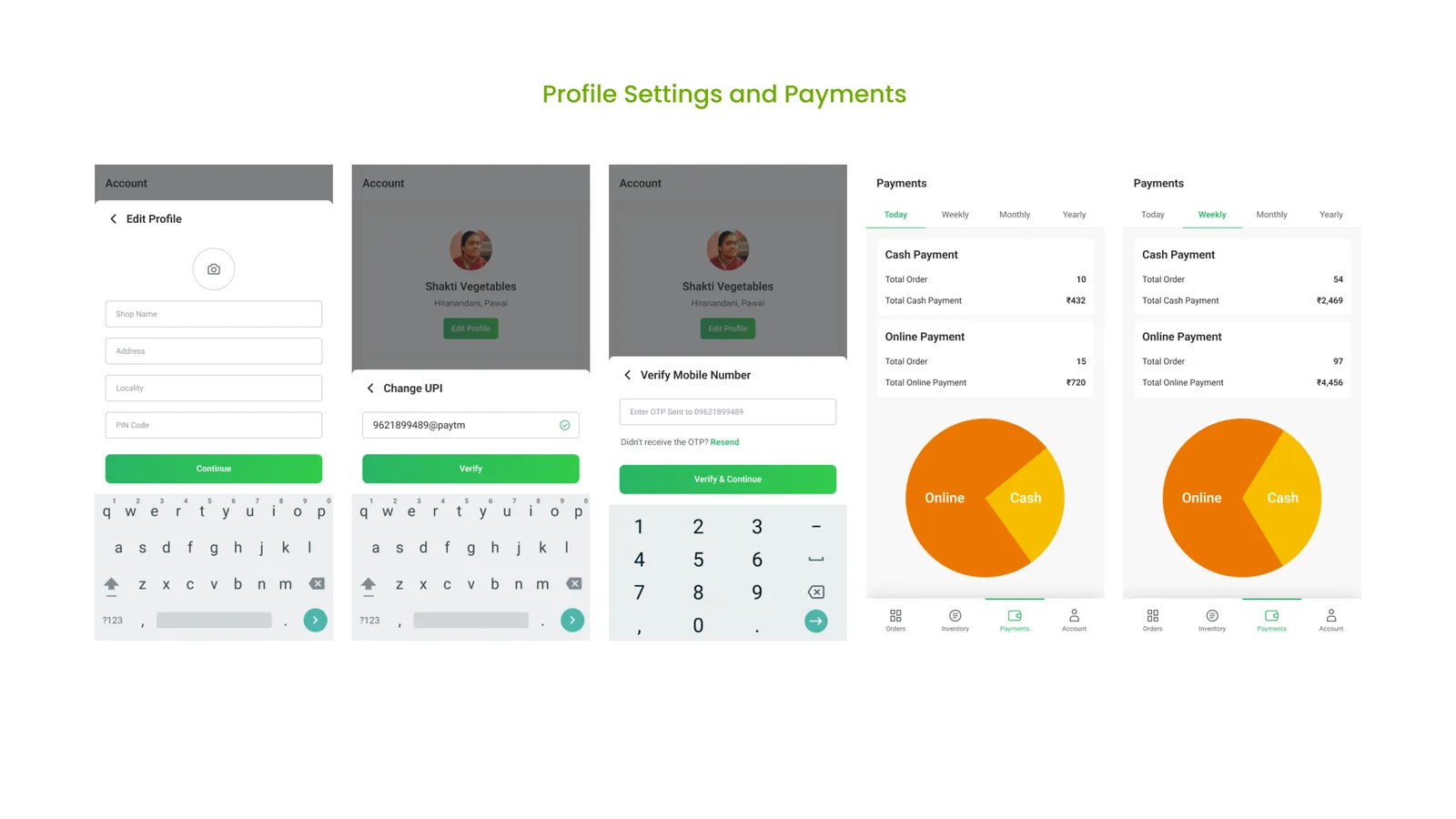
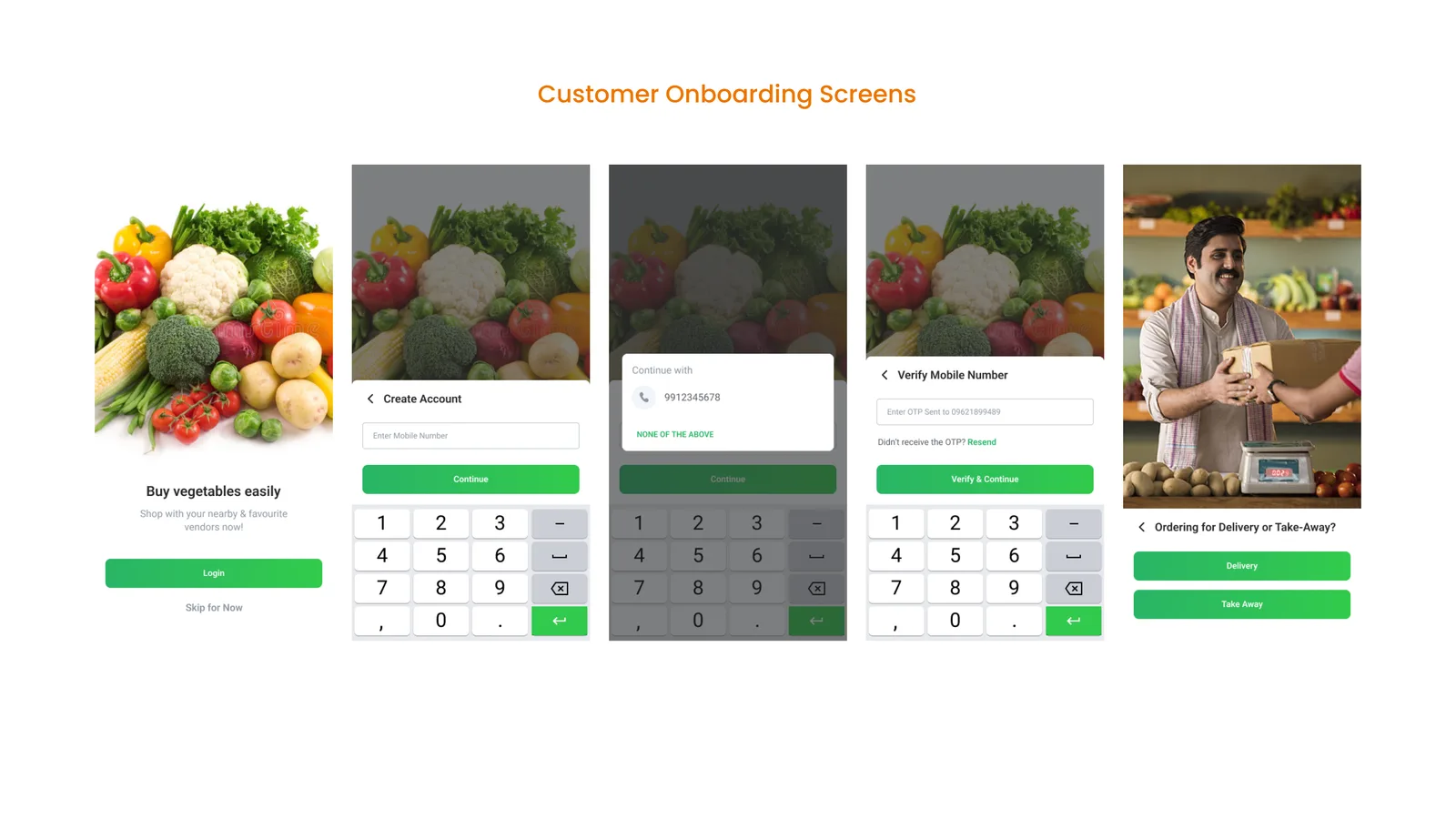
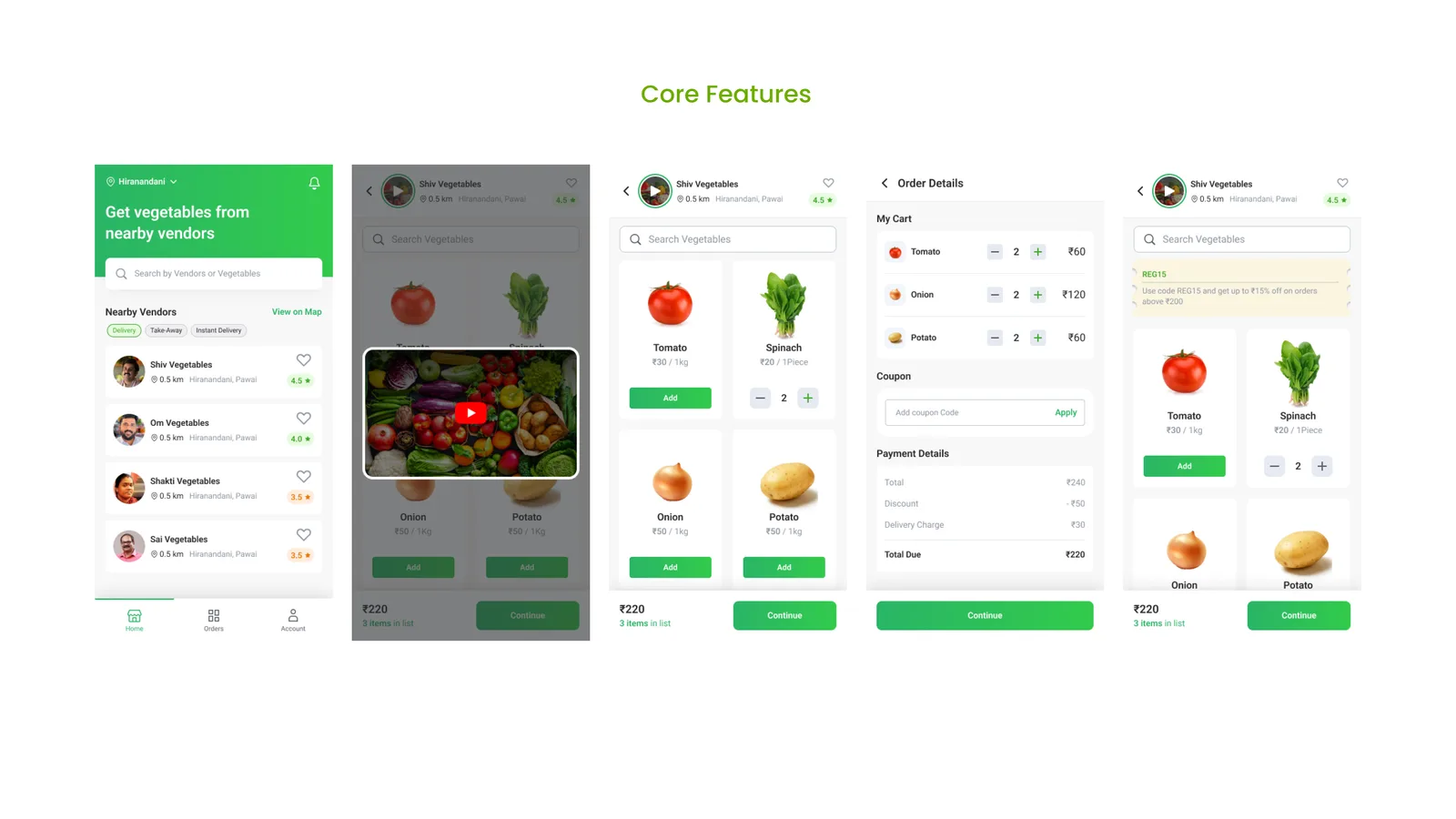
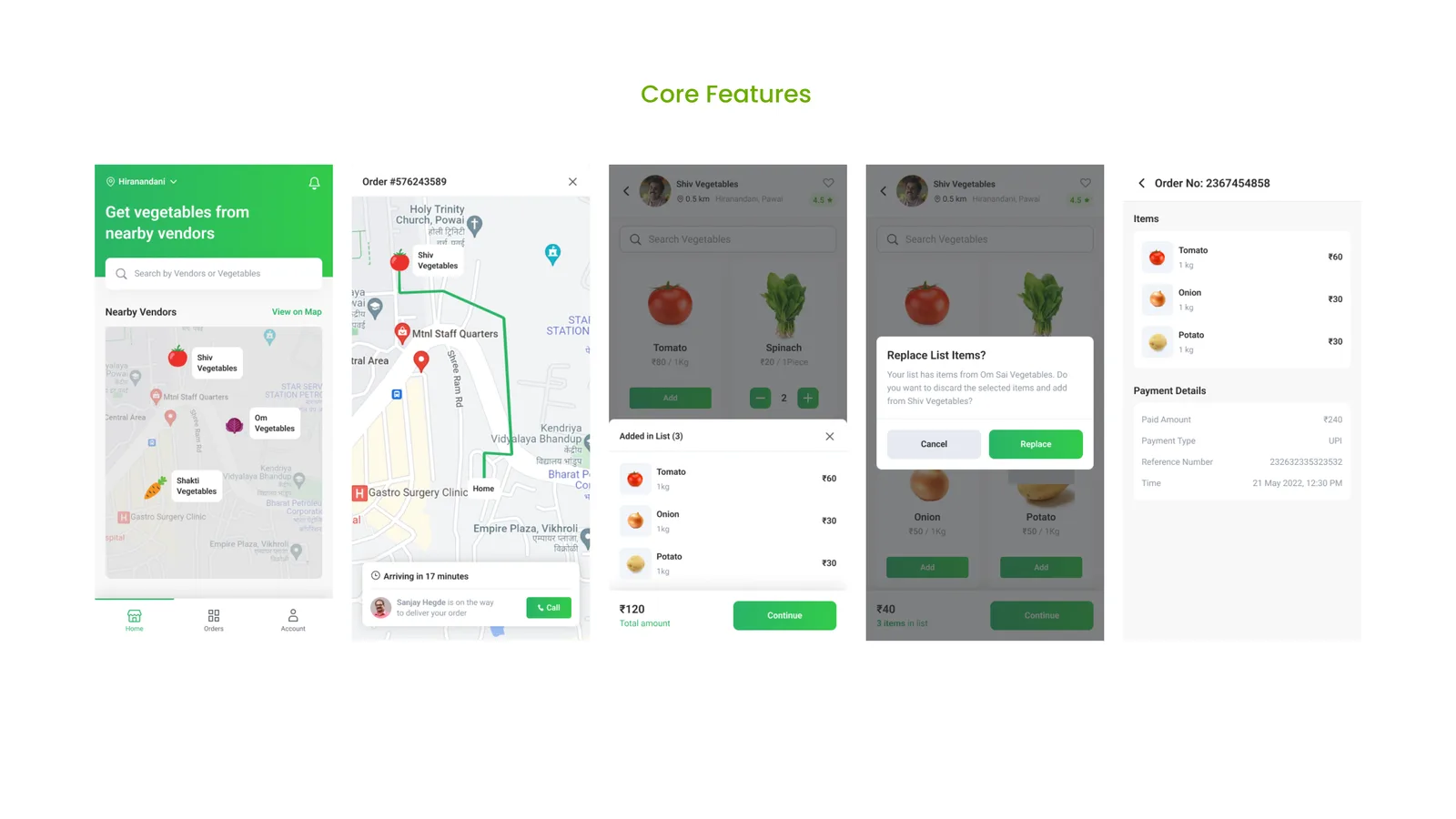
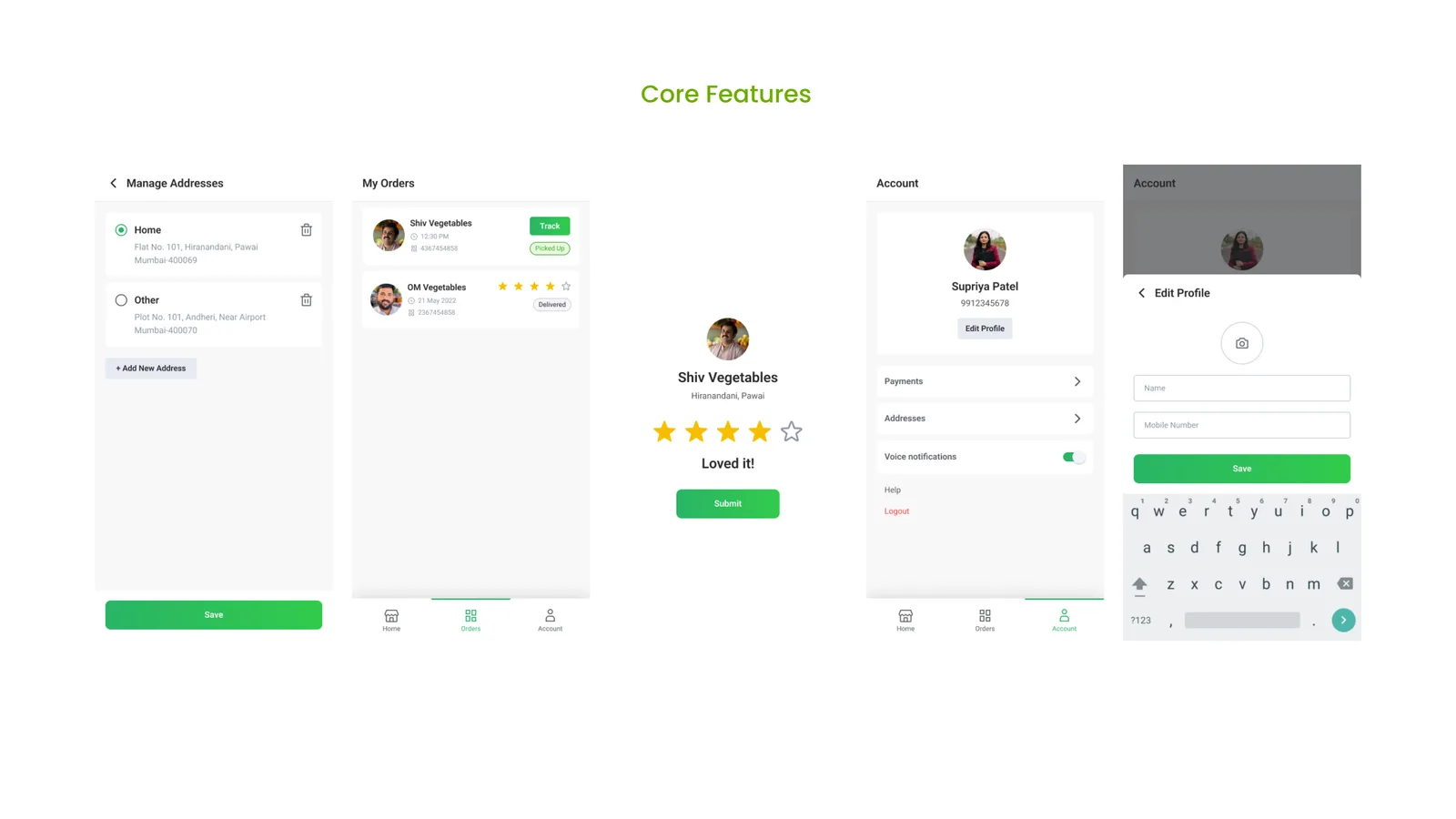
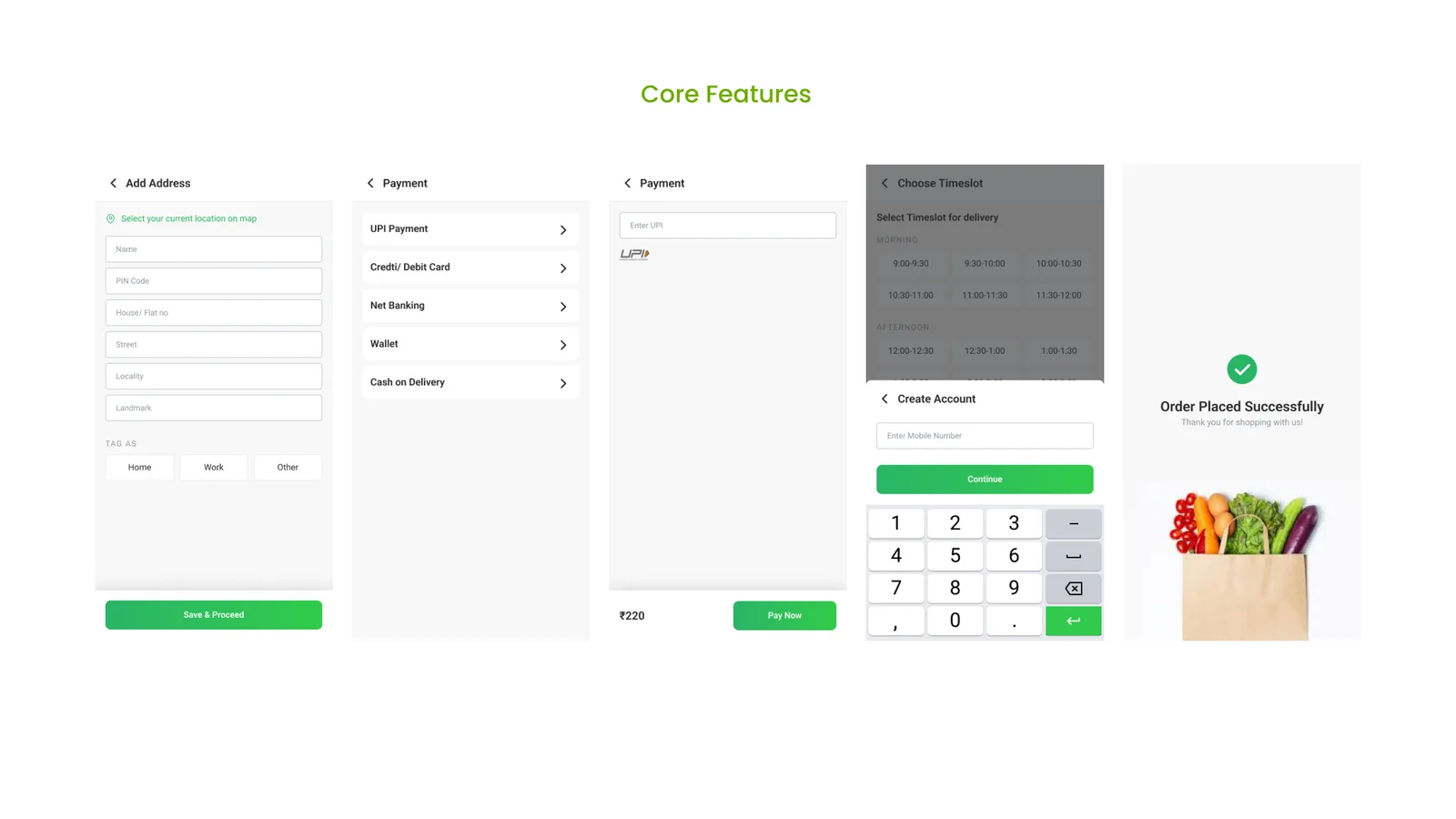
Sabjiwala title slide: a vendor's photo beside a mobile app mockup, with the role (UX Researcher & UX Designer, End-to-End Project).Problem Statement slide: during the lockdown, a surge in demand for home delivery of fresh fruit and vegetables led people to continue ordering from their preferred local vendors through apps or click/call/WhatsApp. Initial Brief and Target Audience sections below (Local Vegetable Vendors; Consumers who shop online; Consumers who shop in person).Design Thinking Process overview: Emphatize (Desk Study, Contextual Inquiry & User Interviews, Interpretation, Affinity Mapping), Define (User Personas, Goal Statement, Defining Brief, Scenarios), Ideate (Brainstorming and Ideations, User Flow), Design (Paper Wireframes, Low Fidelity Designs, Visual Design, High Fidelity Designs, Prototype), Test (Usability Testing, Improvements).Project Timeline: a Gantt-style chart staggering the Empathize, Define, Ideate, Design and Test phases across the project's days.Emphatize Phase — Desk Study slide with six statistics on people's preference for buying from local vegetable vendors versus online shopping.Contextual Inquiry methodology slide: Why (understanding the physical environment vendors and consumers interact in), Where (bustling local market areas; a total of 10 vendors and 12 customers interviewed), Who (vendor and customer backgrounds), a map of the region studied, and the Focus Set of topics targeted for vendors and for customers.Flow model diagram mapping the chain between local suppliers, vendors, transporters and customers.Sequence model table outlining a vegetable vendor's step-by-step operations, the intent behind each step, and potential breakdowns.Artefact Model: four numbered photos showing a customer placing an order over WhatsApp, the vendor confirming by message, a customer's physical bill prepared by the vendor, and the vendor's paper ledger of credit and orders.Interpretations from Contextual Inquiry: a spreadsheet sorting interview interpretations into observations, user statements, breakdowns and design ideas.Affinity mapping board grouping interpretations from the contextual inquiry into common themes.Insights and Key Observations from Contextual Inquiry, covering vendor and customer behaviour patterns found during the interviews.Define Phase — Key Problems Faced slide, listing distinct problems for vendors and for consumers.Vendor persona: Rajesh Kumar, with age, education, occupation, location, brief background, frustrations, needs and motivations.Customer persona: Samriddhi Gupta, with age, education, occupation, location, brief background, frustrations, needs and motivations.Vendor Scenarios and Customer Scenarios, each as before/after pairs: a vendor's awareness about selling online, a vendor's business during the rainy season, a customer's emergency situation, and a customer's recent/regular orders.Ideate Phase — Brainstorming session with four participants, presenting six concepts for delivery, resale and subscription features.Final Brief (Goal) slide: the vision statement, 'The go-to platform for connecting local vegetable vendors and customers,' plus the Solution Definition and Business Model.Design Phase — a grid of hand-drawn low-fidelity wireframe sketches for the app's core screens.Design System slide: primary, neutral and accent colour swatches, plus heading, body and button type styles.High Fidelity — Final Design slide with two annotated phone mockups: the Vendor's Homepage (order name, view order, ready to deliver, record video, navigation bar) and the Customer's Homepage (list of nearby vendors, map, navigation bar).Vendor Onboarding Screens: a welcome/promo screen, account creation and mobile number verification.App Setup for Selling: creating an account, selecting vegetables to list for sale, and setting up UPI payment.Core Features (vendor): recording a produce video, the New Orders / In Progress / Ready to Deliver list, and inventory management.Profile Settings and Payments: editing profile details, verifying mobile number and UPI, and a Cash/Online payments breakdown with charts.Customer Onboarding Screens: fresh-vegetable photography, account creation, mobile number verification, and choosing delivery or takeaway.Core Features (customer): browsing nearby vendors on a map, selecting produce, and building an order.Core Features (customer): live delivery tracking on a map, reviewing order items, and confirming the order.Core Features (customer): managing saved addresses, order history, and rating a vendor after a purchase.Core Features (customer): adding a delivery address, choosing a payment method, and an order-placed confirmation screen.
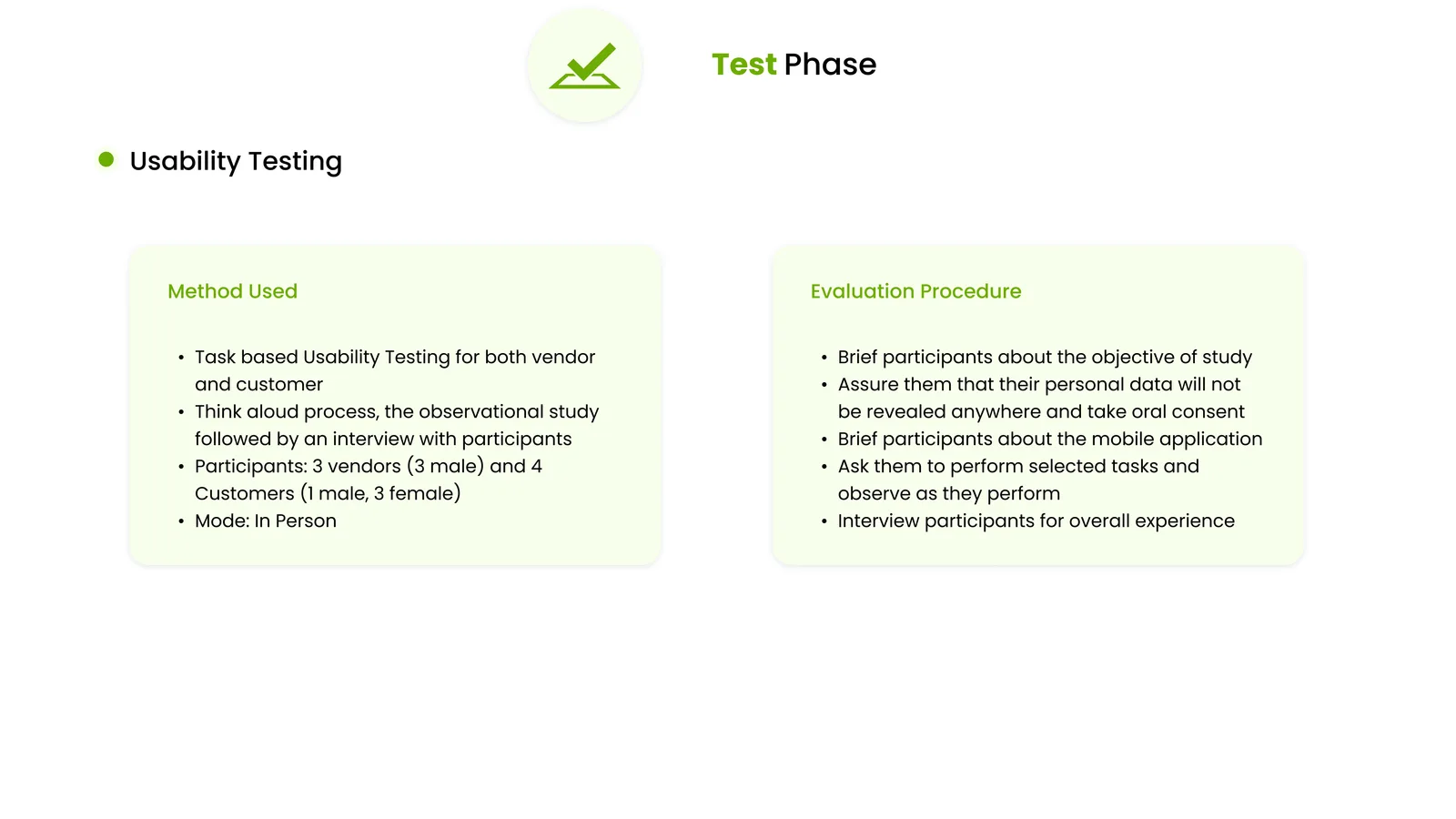
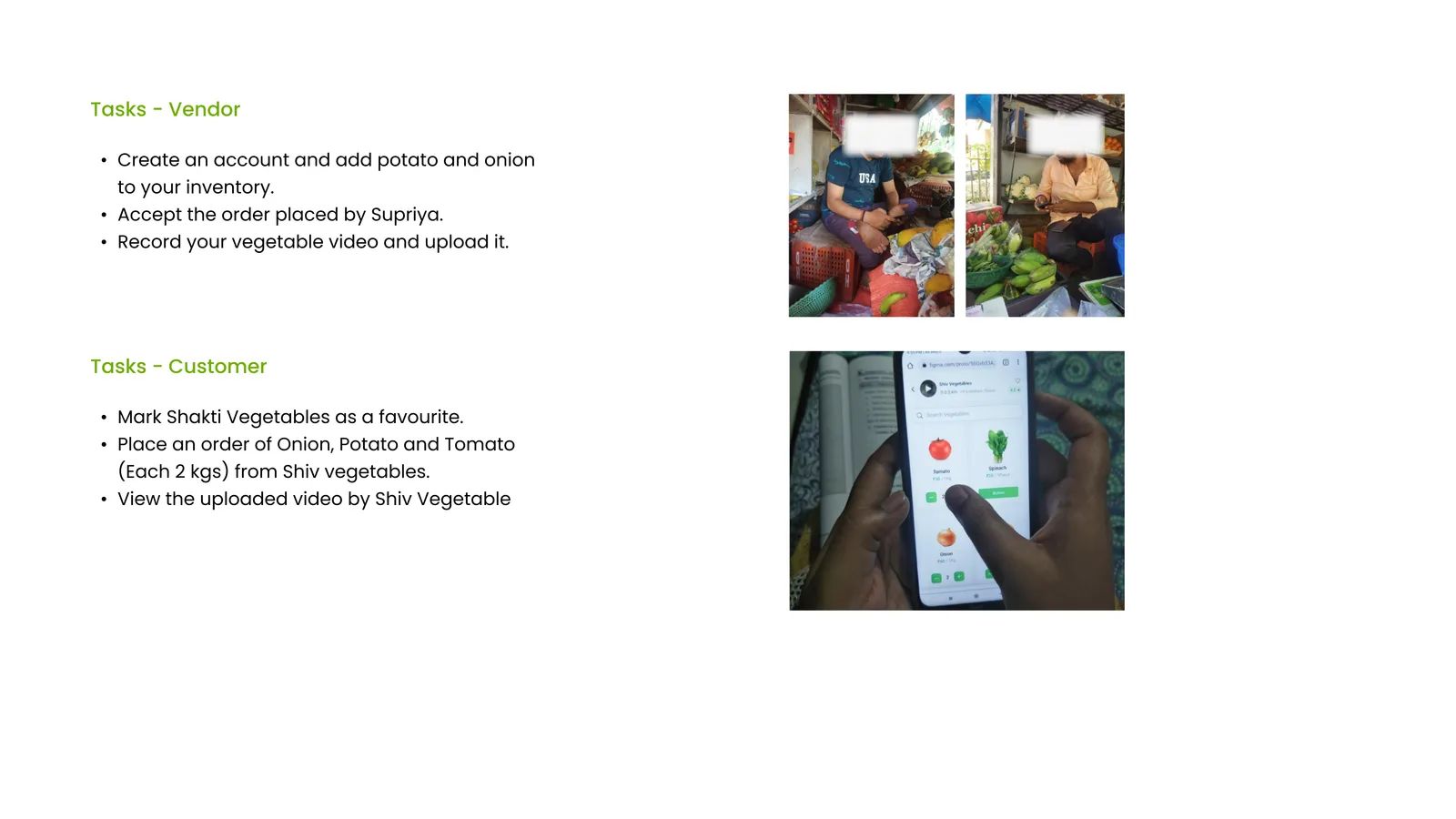
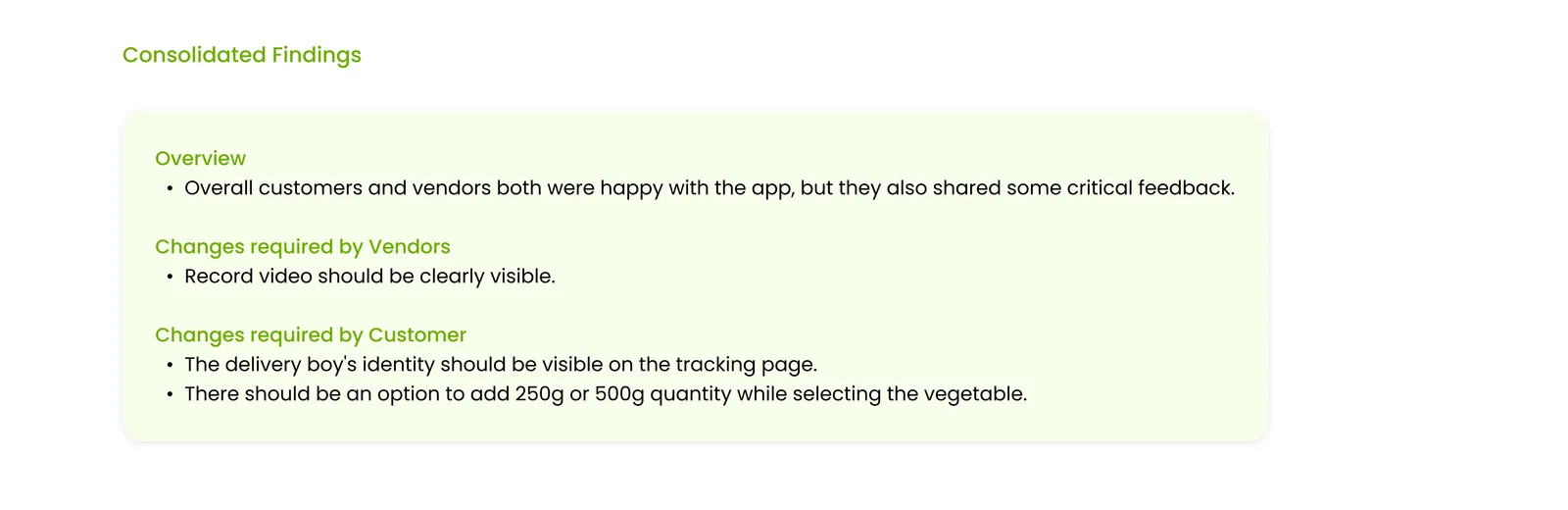
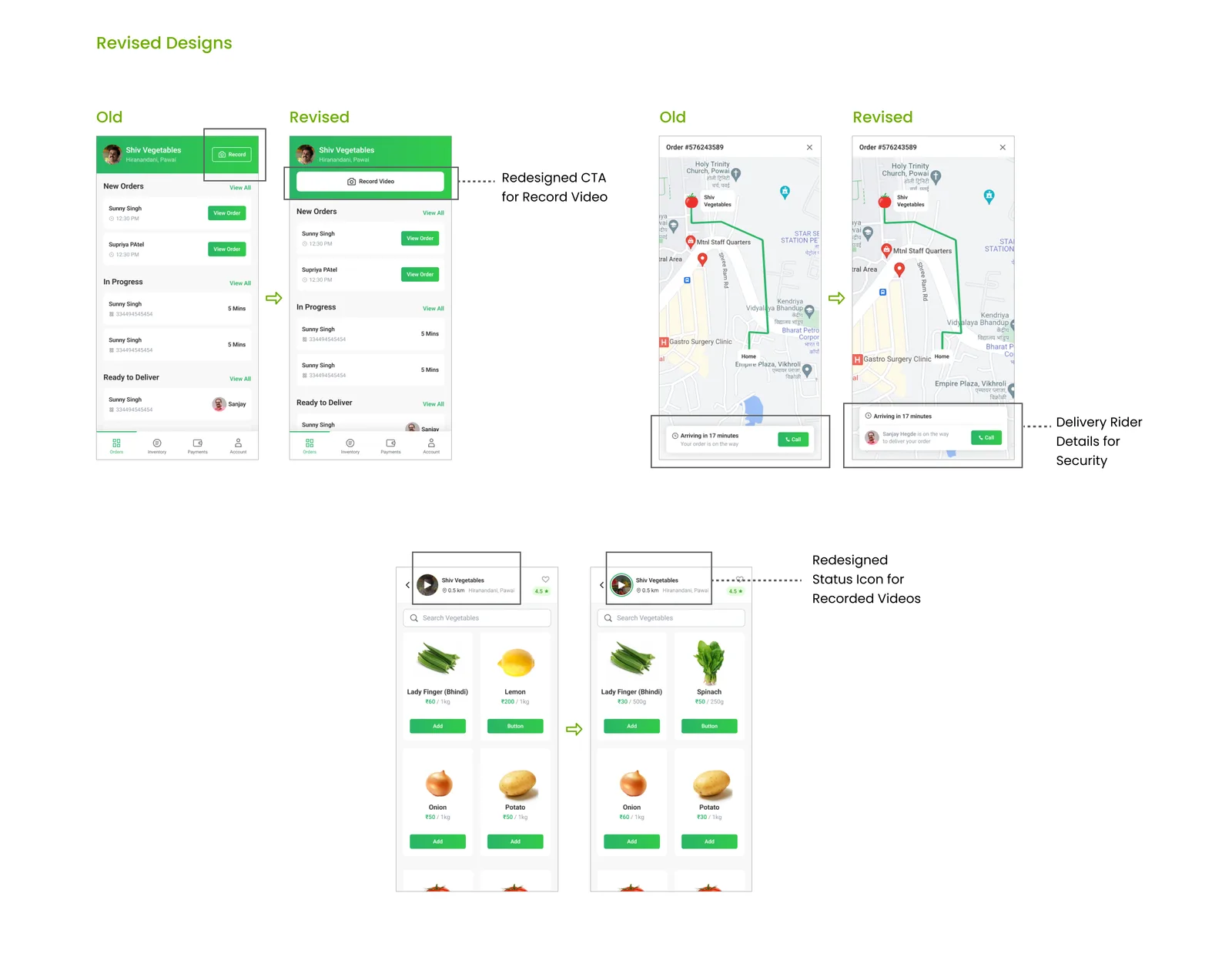
Test Phase — Usability Testing slide: task-based testing with 3 vendors and 4 customers, in person, using a think-aloud process; the evaluation procedure followed for each session.Usability testing tasks: vendor tasks (add inventory, accept an order, record and upload a video) and customer tasks (favourite a vendor, place a multi-item order, view an uploaded video), with photos of participants completing them.Consolidated Findings: customers and vendors were largely happy but shared critical feedback — the record-video control needed to be clearer, and customers wanted delivery-rider visibility and 250g/500g quantity options.Revised Designs: three before/after pairs — a redesigned Record Video CTA, delivery-rider details added to order tracking for security, and a redesigned status icon for recorded videos.